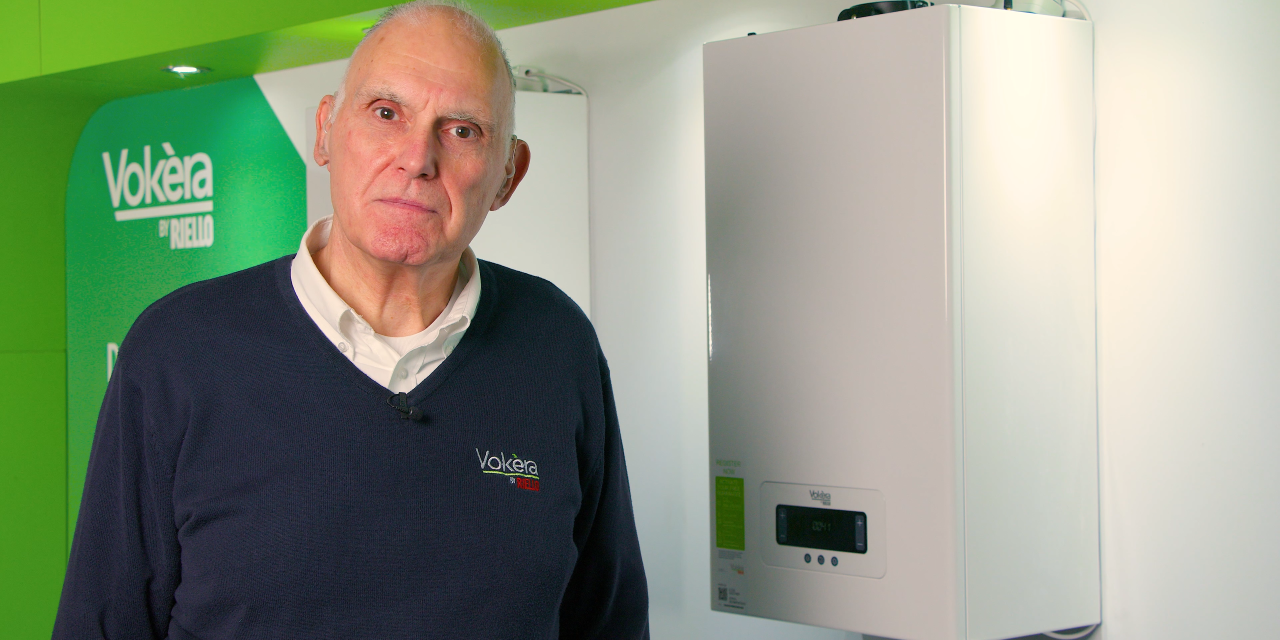
David Iszchak has been Technical Trainer at Vokèra for over 15 years. We caught up with David to discuss how the heating industry is changing, why ongoing training matters and how installers can make the most of modern boiler technology.
David, you’ve spent more than 15 years training installers – what industry development or regulation change has had the biggest impact on installers during this time?
Obviously, the biggest change has been the move to de-carbonise all heating, with the adoption of heat pumps in the mainstream central heating installation trade. This has necessitated completely different training courses, incorporating not only the source of heat but also revised survey and installation practices. Installers also need an awareness of governing legislation and compliance requirements. We include all of this in our heat pump training course.
How have the skills required by installers changed over the years – are there some that are no longer required or vice versa?
I don’t think any existing skills can be ignored for at least the next two decades, as many customers will be using and maintaining their existing systems for years to come. What I delight in is seeing how many installers who have investigated, if not wholeheartedly adopted, heat pump installation now take a greater interest in low temperature control systems. They increasingly consider utilising features available on better-specified boilers to maximise the efficiency of boiler systems. This might not progress Net Zero as fast as the government wish, but it certainly reduces carbon emissions and is an oft-neglected step in the right direction. In addition to modulated flow control, which has been available for many years but often ignored, installers and customers now look at range-rating the heating output of boilers following a more realistic heat loss assessment, using BUS controlled circulators, adjustable anti-cycle delay and Vokèra’s soft-start features to reduce cycling.
What have been the most notable advancements in boiler technology over the years?
Domestic gas boilers reached the zenith of potential efficiency some years ago; I would describe many of the features attracting attention today not as new advances, but as ‘now noticed’. Installers are increasingly looking to use the features a boiler already offers, rather than simply install it in the basic configuration. This ‘install as is’ approach usually means an unnecessarily high heating output, too simplistic a control strategy, unnecessary cycling and fuel wastage. One recent feature that is increasingly available is active combustion control. This automatically monitors the air/fuel mix (Lambda) and continually adjusts combustion to help minimise emissions.
Are today’s boilers easier or harder to work with than previous models?
Are they harder to work with? That’s a good question. Many models have a combined pressure relief and condensate outlet which makes the physical installation a little easier. Boilers are generally lighter now and servicing and maintenance can be carried out entirely from the front. That’s certainly the case for all current Vokèra models. Where a little effort reaps rewards is reading the manual thoroughly to understand the features that improve performance after the installation. These include a smart, free pre-heat option and two ignition speeds. When the burner shuts down because the system has reached its setpoint, the next ignition uses a lower energy input than at a cold start. Most ignition sequences are warm starts, not a system-cold start. These help to avoid high power inputs to already warm system water and triggering a cycling sequence known as micro-firing.
Why is ongoing training more important now than ever?
Ongoing training matters because the features I’ve mentioned, which have been available on Vokèra boilers for years, are generally overlooked. Training introduces the installers to what those features can do and how to use them correctly.
What are the most common knowledge gaps that you encounter during training sessions?
I have to answer that by saying system design: an appreciation of heat loss and sizing to the actual property heating load, pipework and radiator sizing, and control options. Rightly, much emphasis is placed on safely using fuels, through Gas Safe and Oftec qualifications, for example. But without a formal apprenticeship, system design and the implications of poor or non-existent water circulation design can be overlooked. This leaves half the installation neglected, or perhaps not neglected, but unrefined and a crude oversimplification.
Are there any common misconceptions about modern boilers, or anything you see installers underestimating?
I seem to be banging the same drum in answer to each question but again the misconception that a boiler is supplied ready to operate optimally, whether it is installed in a two-bed flat or a five-bed detached house. It will operate passably but not optimally, and passably is not ideal.
What do you think are the biggest challenges facing installers today?
Legislation drafted by people who do not install themselves – and the consumer’s expectations, both technically and economically.
What skills will the next generation of heating engineers need?
Skills are secondary, they naturally follow dissatisfaction with the way things are. Always look at work you see being carried out, both good and poor, and take in what you see. Then decide whether you want your own work to be passable or whether you would rather be better than you were yesterday. The necessary skills are the end result of this scrutiny.
With the future in mind, what piece of advice would you give today’s installers to help them stay ahead of the game?
This is a great trade that is ever changing. It’s never boring as no two jobs are exactly the same, and the sky is as high as you wish it to be. Look after your eyes, knees, back and hearing and go for it. If you don’t like it, get out of the way and make room for someone who does!
For more information on Vokèra, its product range and installer support, visit www.vokera.co.uk