
Described as a crucial time for the UK oil heating industry, delegates who attended this year’s OFTEC conference were provided with an update on progress towards developing a low carbon alternative to kerosene in support of government’s decarbonisation plans. The future pathway for liquid fuel heating was the key theme of the event, held on 19th June at The Hilton Puckrup Hotel near Tewkesbury.
Over the last year, OFTEC has looked to highlight the practical difficulties and potential cost to rural consumers of government proposals outlined in the Clean Growth Strategy to phase out high carbon fossil fuel heating, whilst emphasising the viability of low carbon liquid fuels as a practical and cost-effective solution for off-grid homes.
A Department of Business, Energy and Industrial Strategy (BEIS) and OFTEC working group has now been established to co-ordinate discussion and action on the future of the off-grid heating sector, with the first meeting held on 3 May in London. In partnership with manufacturers, the trade association has also begun performance tests on various low carbon liquid fuel blends and a 100% biofuel.
Commenting on the current position, OFTEC CEO Paul Rose said:
The climate change challenge is one we all need to work towards addressing. OFTEC fully supports the Government’s decarbonisation ambitions, although how these are achieved for rural households must be reviewed. Over the past year we have been working hard to progress a low carbon liquid fuel solution which offers a realistic, practical alternative to the current options on the table for off-grid homes which are not fit for purpose.
“Now is the time for our industry to unite, step up and act collectively to meet the significant opportunity decarbonisation brings. This means everyone from installers and manufacturers to fuel suppliers and refiners playing their part. Much progress has been made to date, and against an undeniably challenging backdrop, but we need to keep this positive momentum going and deliver a futureproof solution that works for consumers and government alike.”
OFTEC was joined at the conference by guest speaker Richard Vianello, Renewable Heat Incentive & Heat in Buildings Deputy Director at BEIS. Richard provided a summary of current government thinking on heat policy, including the recent ‘call for evidence’ on the Future Framework for Heat in Buildings, to which OFTEC submitted a detailed response. He said that BEIS had received over 150 responses and, although many stakeholders had very different views, the Government is hoping to issue a formal response in the autumn.
Richard acknowledged the important role of installers in educating the public about low carbon technology and that decarbonisation needs to be a gradual process, but he also pointed out that if the Government is to meet its 2050 targets then it is unlikely that any more oil boilers could be installed after 2035.
Dr Ernst-Moritz Bellingen, Energy Policy Director of the German Institute for Heating and Oil Technology (IWO), also provided an overview of the positive developments in low carbon liquid fuel production.
Guests then heard from Andrew Robertson, co-founder of Clean Energy Consultancy Ltd who was involved in OFTEC’s successful biofuel project (2008-2011) which delivered a 30% renewable liquid fuel called B30K. Andrew talked through the customer journey when opting for renewable heating solutions such as heat pumps and biomass, highlighting the potential barriers to take up in a retrofit situation whilst emphasising the benefits of switching to a low carbon liquid fuel.
OFTEC Chair Niall Faye of Grant Engineering concluded:
The journey to provide decarbonisation solutions continues. Heat pumps have been promoted by many as the answer to low carbon heating for off-grid homes. However, the poor thermal efficiency of rural homes and the widely evidenced failure of the domestic Renewable Heat Incentive (RHI) highlights the practical difficulties and prohibitive cost of retrofitting these technologies.
“More cost-effective options must be found and this means a crucial role for low carbon liquid fuels going forward. By drawing together the strengths of our innovative industry, I am confident we will be able to produce an alternative fuel to power off-grid boilers well into the future.”
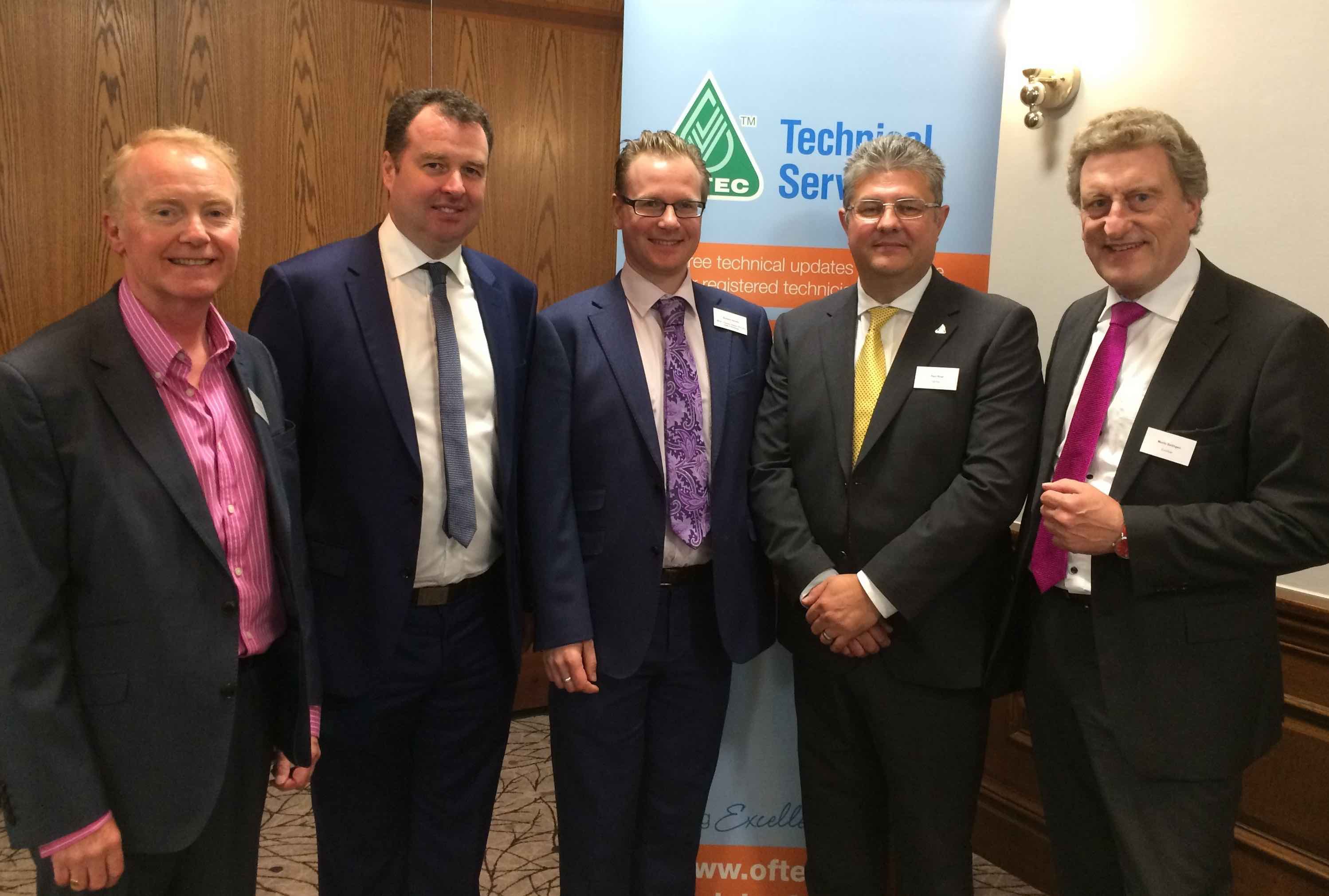
Pictured at the conference (left to right) are: Andrew Robertson, Niall Faye, Richard Vianello, Paul Rose and Dr Ernst-Moritz Bellingen.
