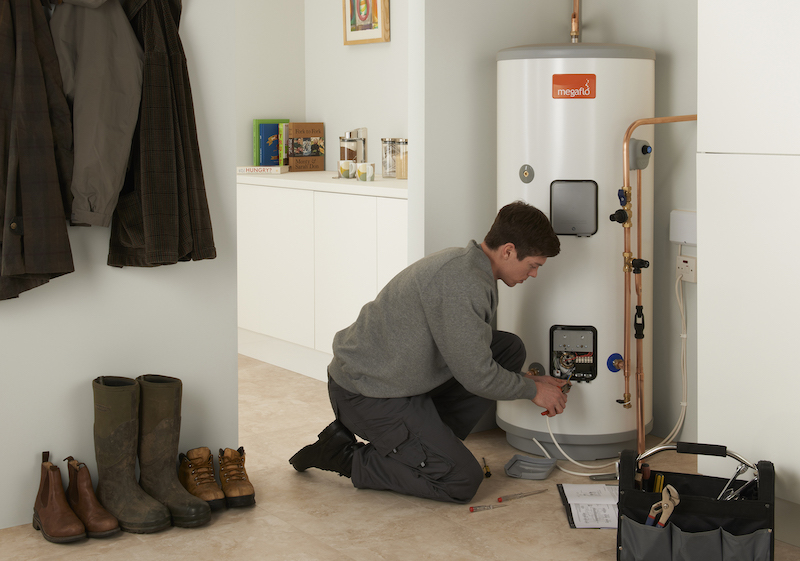
Unvented hot water cylinders were legalised in the UK in 1985 and have grown rapidly in popularity. Despite this, there are still a number of commonly believed myths that persist in the industry. George Linder, Product Manager at Heatrae Sadia, looks to put things right.
As unvented hot water cylinders become ever more popular, it is important to address some of the most pervasive myths:
(1) They’re only suitable for large premises.
For a long time, having a hot water cylinder meant needing a large cold-water tank. This would often have to be placed in the loft, which not only used up valuable space, but was also prone to freezing during long cold snaps. However, unvented hot water cylinders remove the need for these bulky fixtures because they draw water directly from the cold-water mains, making them a great option for properties limited on space.
(2) They don’t need to be serviced.
This is one of the most widespread myths, but hot water cylinders need service checks to be carried out every 12 months. This is often a condition of the manufacturer’s warranty and is vital in checking the safety features associated with unvented systems. Water expands when it gets warm, which means there needs to be mechanisms that ease pressure in the cylinder. There are two main ways of doing this, either with an internal bubble top unit, or an external expansion vessel. Whichever method is used, it is crucial that these are regularly checked in order to maintain the safety, integrity, and performance of the hot water. To help consumer understanding of the need to regularly service a cylinder, the Hot Water Association (HWA) has launched a free-to-download best-practice guide to servicing a hot water cylinder.
(3) One size fits all.
The size of the cylinder should vary according to how much hot water will be used by the homeowner. This depends on the number of people living in the property, but also on the habits of those individuals in the household. Sizing a cylinder will also depend on the number of bathrooms in the property. For instance, many new-builds will have both a family bathroom and an ensuite. This places extra demand on the cylinder and so would impact the size of the unit specified and installed. That’s because there is no set amount of water used in a wash, with the figure changing drastically depending on whether it’s a bath or shower. As a rule of thumb, you should allow between 35 and 45 litres for every occupant, but this figure is flexible depending on the household.
(4) No special training is required, so long as you are Gas Safe accredited.
The higher pressure in an unvented hot water cylinder means they must be fitted and maintained by specially qualified technicians. This means that heating engineers must be G3 certified, which provides the knowledge and skills needed to work with unvented systems. Getting onto a G3 accreditation course requires an NVQ Level 2 or equivalent, but once installers have this, they can get themselves certified through a training centre.
(5) New water cylinders have to go in the same place as the old one.
The level of insulation on the latest cylinders means less restriction in where they can be positioned in the home. They don’t have to go in the same place as the system they are replacing and if properly protected from extreme cold temperatures, the garage and loft are just two of the options available. This can free up space in the home, opening up the possibility to use old airing cupboard space for other needs – such as another shower or a walk-in wardrobe.