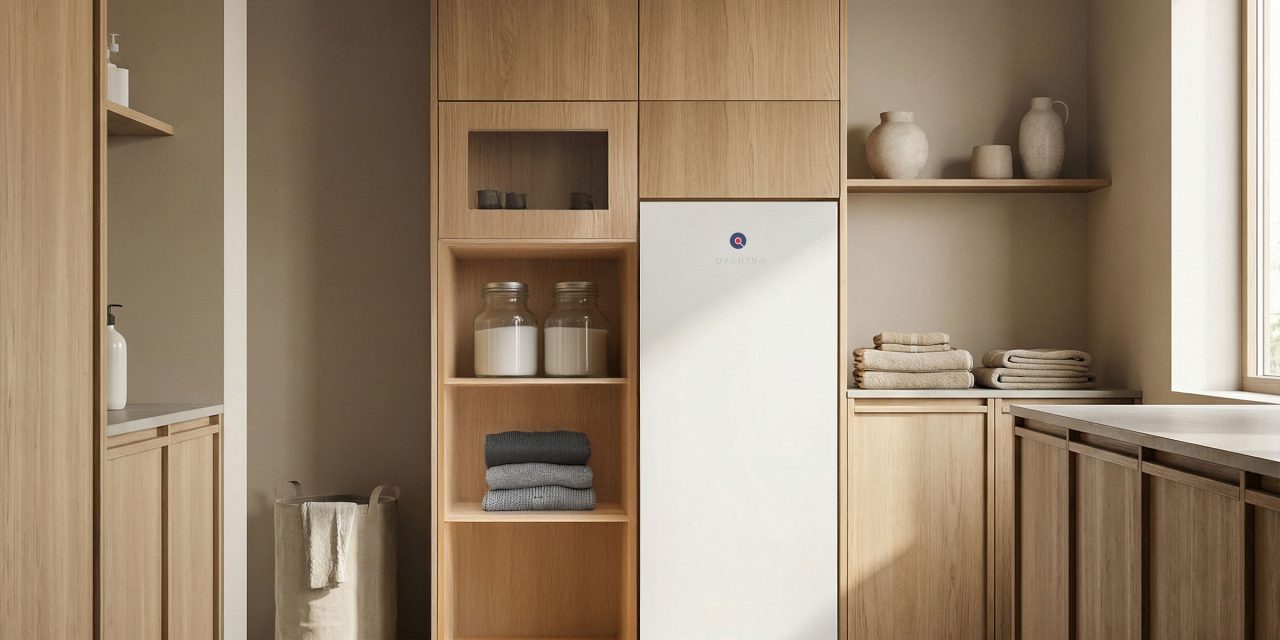
Targeting urban decarbonisation projects, Qvantum has introduced the QG water-to-water heat pump. It is designed for environments where space constraints, acoustic limits and air quality considerations can make heating system design more complex.
The solution was created for developers working with fifth generation ambient heat networks and shared boreholes across new builds and retrofits in cities. With a wide operating envelope, the QG is suitable for a mix of energy sources, from ground arrays and surface water to centralised plant and waste heat from nearby assets.
The QG delivers heating, cooling, and domestic hot water in a single integrated unit, featuring an accumulator tank that acts as a thermal battery with heat storage up to 90°C. With FlexReady functionality and API connectivity, it optimises energy use by operating during periods of low electricity prices or renewable surplus and is ready for flexible energy markets. Domestic hot water is produced instantly via a heat exchanger, eliminating legionella risk and simplifying water quality requirements.
“At Qvantum, we are committed to creating products for the harder to solve projects – for example the challenge of decarbonising urban homes. We believe that you can find real advantages in planning residential energy systems in the context of the wider urban environment. The QG is a solution that allows you to take advantage of heat that is being wasted elsewhere to create a system that benefits the homeowner, the property developer and the wider community,” says Philip Ord, UK CEO.
The QG uses R290 refrigerant and is available with either an inbuilt source-side pump for individual or shared ground source systems, or a PIC-valve (QG-C) for ambient loop applications, in 7 and 14kW variants.