The challenges are mounting for workers in the plumbing and heating trades as a growing skills shortage, compounded by the ageing workforce and a decrease in new recruits, plagues the industry. This is according to Marius Stӓcker, CEO of ToolTime, who says the consequences of all this – in the face of other external factors such as the cost-of-living crisis – include declining mental health for professionals in the industry, and a serious lack of incentive for the younger generation to pursue a career in plumbing and heating. Here, he considers how digital solutions can address some of these issues.
The UK Trade Skills Index 2023 revealed that demand for plumbers is set to soar and that as many as 70,000 new recruits are needed by 2032 to meet it. The Chartered Institute of Building revealed that nearly two thirds of the construction workforce, including those in plumbing and heating, are over 35 years old, and that the total number of construction workers under the age of 30 is decreasing at the fastest rate of all age groups.
The interdependent nature of these challenges makes it extremely hard to tackle one element without addressing the others. Many are asking questions about where to start.
One solution that has come to the fore is digitalisation, with new platforms emerging to deliver productivity gains that tackle skills shortages, as well as modernising for the next generation. Job management solutions are giving precious time back to those who need it – a critical mission in the battle to achieve a better work-life balance and create space to grow customers and increase revenue. But, importantly, digitalisation is also helping to make the plumbing and heating trades more attractive to young people. Failing to adopt change may result in businesses being left behind as others take the leap.
Digitisation for attracting young talent
The first step in tackling the challenges facing the plumbing and heating industry is to attract younger generations into the trade. The 2022 report from early careers experts Prospects reveals that just 12% of school leavers planned to pursue an apprenticeship, there is a mountain to climb. Wavin’s annual ‘State of the Nation’ Survey suggests this might be due to businesses already operating at max capacity, with 65% of plumbers reporting an increase in callouts due to customers not turning their heating on during the cost-of-living crisis and therefore having problems when they then tried to use it, and 60% saying they were being forced to turn work away due to not having enough resources. Clearly, carving out more time for experienced workers to train the next generation is of great importance.
The problem of attracting young people in the first place however may be that this generation – the first true digital natives – have grown up with technology and are highly adept at using it. They expect no less from their employers, both in the way in which they interact at the recruitment stage, and in day-to-day business operations. It’s no secret that the trades have been slow on the uptake, tending to rely instead on more traditional methods such as pen and paper, or software like Word and Excel that have limited functionality for complete business management. But there are practical steps that businesses in plumbing and heating can take to address this.
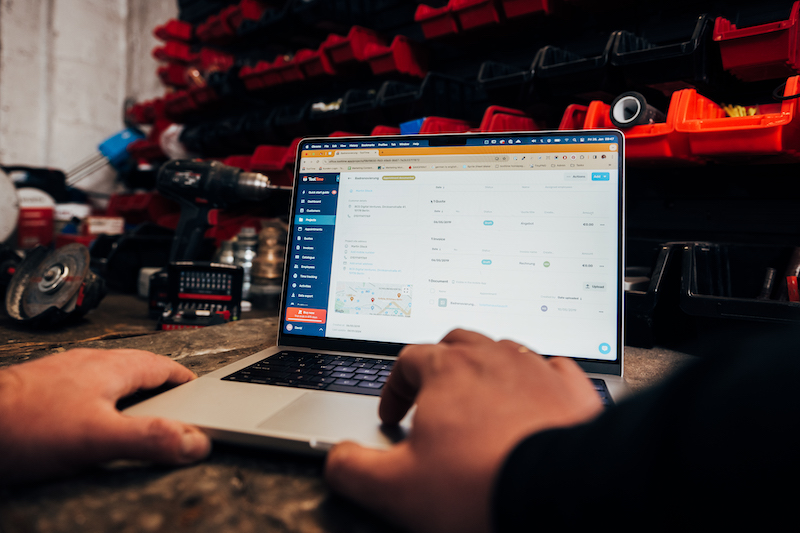
Job management software can now automate much of the tedious administrative work, such as quote generation, customer reminders, diarising appointments, and invoicing. Our customers report average time savings of 30%. Moreover, cloud-native solutions enable work from anywhere, allowing employees to log activity and vital customer information via smartphone or tablet while in the field, minimising time spent needing to track back to an office or completing paperwork from home.
These efficiencies mean there’s more time to support youngsters with their practical skills, and undoubtedly, a company using the most current and advanced technology will prove more attractive to new talent than one for whom the old pen-and-paper ways endure.
Long-term gains
Once digital tools carve out time for training new recruits, the other challenges become easier to tackle. Young talent will add to the productivity gains generated by digitalisation, making it easier for more experienced workers to focus on training, bringing in new jobs, and delivering great customer service that keeps clients coming back. Workloads will become more manageable, and everyone will be able to finish on time – including business owners who will no longer need to dedicate evenings and weekends to paperwork.
A recent study by IronmongeryDirect revealed that 70% of plumbers say they struggle with mental health issues, which is another area that can be addressed by improving the workload of people in the plumbing and heating trades. Having a healthier work-life balance can reduce stress at work, whilst having more time to invest in the business and revenue generation can contribute to reducing anxieties around finances and job security.
Embracing change
The key to achieving success with digital tools is to address common resistance to change in traditional industries like plumbing and heating.
Over the last decade, these tools have become cheaper and easier to use, and there’s a lot more support on offer at the onboarding stage to make sure businesses know how to get the best out of them. This is really important because the nature of onboarding a new platform already creates heightened levels of anxiety and stress, and many small businesses cannot afford to have a difficult transition period. It must be intuitive to use and start delivering results from the outset. Implementation needs to be strategic, with clear communication between the vendor and the business to ensure that the digital tools chosen can deliver on promised outcomes from day one.
Shifting attitudes to help those in the trades view digital tools in a more positive light is critical. Once plumbing and heating engineers start to understand that technology can give them back more time to spend on doing a good job, getting a better work-life balance, and growing their businesses, taking the leap will seem far less daunting. Once this shift occurs, we can expect to see new digital tools support the recruitment of new workers into the trades and contribute to an overall improvement in the mental health of workers as a result. This represents a promising future for the industry.
https://www.tooltime.app/uk/plumbing-app