Craig Dolan from Dimplex provides expert advice for installers aiming to expand their low-carbon portfolio in 2026 by incorporating domestic hot water heat pumps, highlighting why this technology is ideal for delivering efficient, compliant systems that cut costs and carbon.
As we head into 2026, the countdown to the full implementation of the Future Homes Standard (FHS) is well underway. This landmark regulation will require all new UK homes – and many retrofit projects – to incorporate low-carbon heating and hot water technologies in support of net zero goals.
In tandem, energy prices remain elevated, prompting homeowners to seek expert advice on systems that can balance long-term savings, comfort and compliance. For installers, this creates a clear opportunity to recommend efficient, low-carbon solutions which help customers reduce running costs. For installers under increasing pressure to provide solutions for the decarbonisation of new and existing UK homes, domestic hot water heat pumps are an effective solution.
DHWHPs in brief
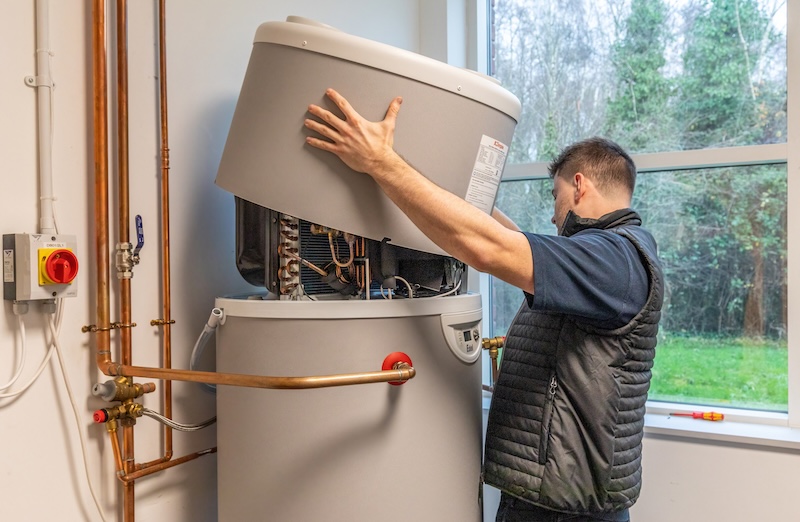
A domestic hot water heat pump (DHWHP) is an energy-efficient system designed to produce hot water using renewable energy. It combines a water cylinder with a compact heat pump unit, usually mounted on top, and operates using a ducted air system that draws in fresh air. Inside, a small refrigeration circuit captures and transfers heat energy into the water cylinder.
Unlike traditional air source heat pumps, most DHWHPs don’t require an external unit as everything is self-contained indoors. This makes them particularly well-suited for apartments, smaller homes, and retrofit projects where external space is limited. Visually and in footprint, they’re similar to a standard hot water cylinder, yet require minimal servicing and maintenance.
When used as the primary source of domestic hot water, DHWHPs can free up installers to specify smaller, simpler systems for space heating, such as electric panel heaters, electric radiators and high heat retention storage heaters. With the UK electricity grid rapidly decarbonising, these combinations provide a clear path toward all-electric, low-carbon homes.
Efficiency first
The rise of DHWHPs coincides with the changing demands of modern, energy-efficient homes. In some new builds, hot water now represents the most significant single energy load in the home. That makes the method of generating it a key factor in achieving carbon targets. DHWHPs address this directly, producing hot water up to 60°C using renewable energy extracted from the air.
This makes them ideal for developers, specifiers, and installers looking to comply with Part L and incoming FHS requirements while keeping installations cost-effective and straightforward.
The integrated heat pump in the Dimplex Edel DHWHP range, for example, achieves a coefficient of performance (COP) of up to 3.36 (EN16147). That means for every kilowatt of electricity consumed, the system produces up to 3.36 kW of heat energy for domestic hot water.
For context, even the most efficient modern gas boiler achieves a maximum ‘COP’ of around 0.94 and typically closer to 0.7–0.85 for hot water production. In other words, a DHWHP can be up to three times more efficient than a gas boiler. If the household is on a 100% renewable electricity tariff, the result is a truly zero-carbon way to meet a property’s entire hot water demand.
Simple installation
One of the most significant advantages for heating installers is the simplicity of installation. Most DHWHPs are designed to fit and connect much like an unvented hot water cylinder, as no F-gas qualification or specialist refrigerant handling is required.
The Dimplex Edel units, for instance, arrive pre-wired with integrated controls and can be installed as a standalone hot water solution. The main additional step is ensuring adequate ducting for air intake and exhaust, typically two short ducts positioned through an external wall or into a ventilated space such as a garage or utility room.
Because there’s no external heat pump unit, there’s no need for groundworks, wall brackets, or outdoor electrical connections. This minimises disruption and makes installation suitable for both new builds and retrofit applications, including high-rise developments and heritage properties. Compact and self-contained, DHWHPs are also highly flexible and ideal for apartments, small homes and larger dwellings alike.
Installers should ensure that ductwork complies with Part F (Ventilation) and that the hot water system installation follows Part G (Sanitation, Hot Water Safety and Water Efficiency). Working with a reputable supplier, such as Dimplex, ensures full technical support and access to installation expertise.
For homeowners, the benefits include lower running costs due to high system efficiency, quiet operation, and a compact design for flexible siting. Additionally, smart controls and connectivity options offer easy management and energy monitoring.
Expand your horizons
Installers looking to expand their business opportunities with domestic hot water heat pumps (DHWHPs) can access hands-on, face-to-face training on Dimplex products by becoming Partner members of the Dimplex PRO Installer Club. Designed to help installers achieve the highest standards, the free of charge membership provides access to training on heat pump principles and servicing, as well as a dedicated course on the Edel Hot Water Heat Pump.