
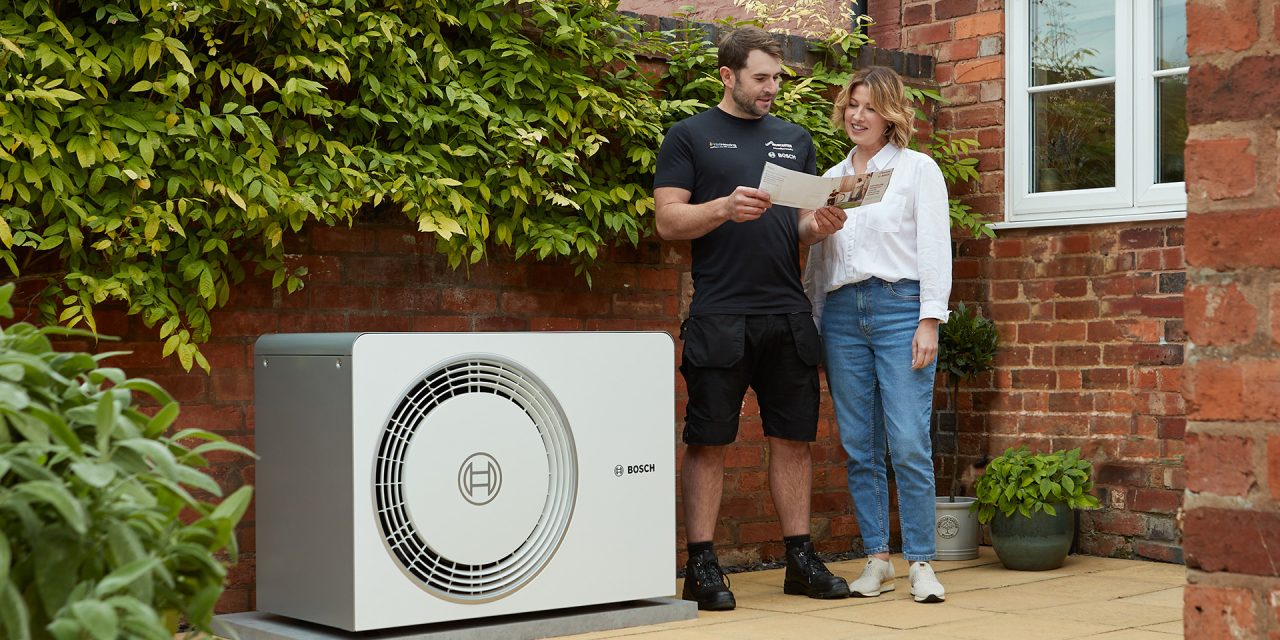
The UK heat pump market might be growing, but it’s at a pace well below that anticipated by the government. Will consumer publicity campaigns help drive further demand? Martyn Bridges from Worcester Bosch reviews the current state of the market and some of the factors likely to influence future sales.
The government continues to heavily promote the sale of heat pumps, part-funded by a number of available grant schemes. This winter, you might spot its charming TV ad, titled ‘Feel All Warm and Fuzzy Inside’, encouraging the public to purchase a heat pump with the help of the Boiler Upgrade Scheme (BUS).
As campaigning efforts grow, the intent is clear: The government wants to drive up heat pump adoption to decarbonise the UK’s domestic heating stock, so let’s review the current state of the heat pump market in the UK.
Market performance
The market shows tentative growth. Heat pump sales figures in the UK reveal 27% growth year-on-year. That’s obviously impressive, but you have to bear in mind that it’s not from an extremely high baseline. On average, around 10,000 heat pumps are being sold per month – probably around 120,000 unit sales in 2025 compared to 98,000 in 2024.
The boiler market is also returning to form, up 3% from last year, but that reflects a huge volume of 1.4 to 1.5 million units.
Unfortunately, we’re seeing a slowdown in heat pump adoption elsewhere in Europe. Once-prolific providers are announcing manufacturing redundancies across the board, and there has been one isolated incident of a UK-based manufacturer having to trim its workforce to align with a shrunken order book.
Air-to-water
The most popular type of heat pump in the UK is the monobloc air-to-water heat pump, accounting for around 80% of all sales.
Domestic hot water heat pumps are also showing considerable growth. These comprise a simple hot water storage cylinder with a small, pre-wired and pre-plumbed heat pump connected to the roof of the cylinder. I presume the driving factor behind this variety’s popularity is new-build property development. A considerably smaller number of air-to-water split heat pumps and ground source heat pumps are also being sold.
Penalty scheme
The Clean Heat Market Mechanism (CHMM) was launched in April of this year, requiring boiler manufacturers to acquire a certain number of credits in exchange for meeting heat pump sales targets.
The expectation was that there would be sufficient demand for heat pumps and manufacturers wouldn’t be hit with punitive fines for missing their targets. However, for the first six months of this year, the CHMM portal has shown fewer registered credits than anticipated. As a result, most boiler manufacturers will be looking at heavy fines in 2026.
I suspect the government thought that every heat pump sold would be registered with the MCS, and so reflected by the CHMM portal – but we’re still seeing a huge number of heat pumps not registered, presumably because they weren’t eligible for funding.
The CHMM only counts heat pumps that have replaced a boiler or are installed in self-build property. So new-build properties, which account for over 40% of all heat pump sales, aren’t eligible for the grant or count towards the CHMM target quota.
Great expectations
The mismatch between expectations and reality is mostly down to a misunderstanding of the UK’s heating market. The government was over-optimistic about the level of demand for heat pumps we would see by this stage, either because it overlooked the numbers or thought the market would grow dramatically.
It’s a supply and demand problem. There was no need to threaten suppliers with fines, because a lack of demand was the issue. The manufacturing base for heat pumps is very capable of delivering all the heat pumps the UK market needs, after all it wasn’t so long ago that 2m heat pumps were being installed annually in Europe!
Hybrid opportunity
We are having ongoing discussions with the government about how to change the fortunes of heat pump adoption. The present growth rate is positive, but it comes from an undeniably small base – and we firmly believe that to drive new growth, the government must extend the BUS to include hybrid heat pumps.
Only recently, Worcester Bosch undertook an important piece of test work that demonstrated that the heat pump element of a hybrid system, in some cases, contributes over 90% of the system’s total output. And that’s when utilising normal, expected winter weather conditions in the UK.
To implement a blanket level of decarbonisation, the barrier to heat pump access must be lowered – and a grant extension to hybrid systems could support that.
Installer confidence
We have also noticed a worrying decrease in the number of MCS-registered installers in recent months, small but nevertheless worrying. If installers are losing confidence in the heat pump market, this could spell a real blow to adoption
It’s also a missed opportunity for the installers themselves, who could expand their services by offering heat pump installations. But that will only happen if there’s consumer demand.
We’re optimistic that the Warm and Fuzzy campaign will encourage uptake. But we also know the biggest issue is the price of electricity. On average, electricity costs around four times the price of gas, making heat pumps a difficult sale to the average homeowner operating a gas-fired boiler.
The government is making several considerations around electricity prices, so we will await proposals in the next few months about how the gap will be addressed. For now, the UK heat pump market will continue to grow – albeit at a slower rate than the government hopes for.
