
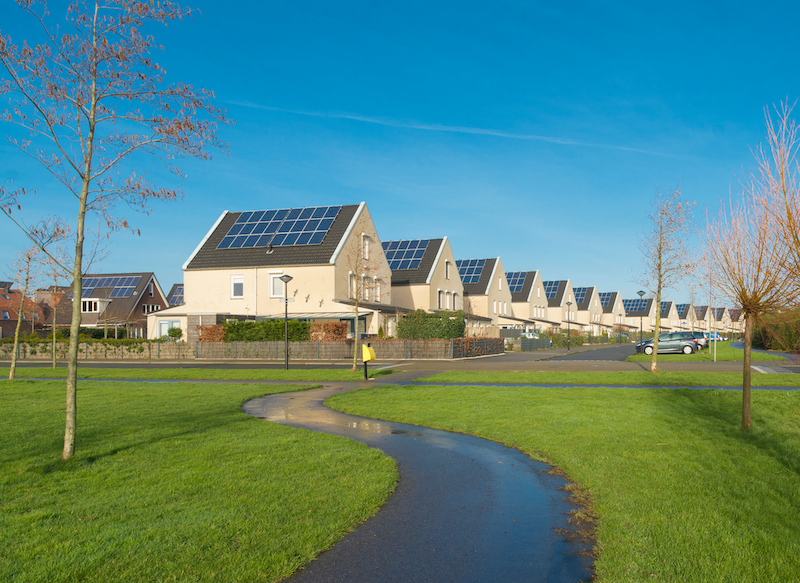
The UK government has launched the long-awaited Future Homes Standard (FHS), but the full rollout – requiring heat pumps and solar panels on all new builds – won’t take effect until March 2028. In the meantime, thousands of new homes will still rely on gas heating, despite soaring energy costs and pressure for faster decarbonisation.
The new regulations implementing the FHS include measures designed to make homes cheaper to run and more energy-efficient. Solar panels and low-carbon heating will become standard, with potential savings of up to £830 a year on energy bills for households compared with a typical EPC C-rated home. New builds will also emit at least 75% less carbon than homes built under 2013 regulations.
The FHS applies only to England, with Scotland, Wales, and Northern Ireland setting separate building regulations. Under the new rules, all new English homes will be off the gas grid, relying on heat pumps or heat networks. Roofs must accommodate solar panels covering 40% of the ground-floor footprint, and smaller plug-in solar panels will be allowed for flats or homes with limited roof space.
While compliance will raise construction costs, the changes are expected to drive long-term savings for households and create market certainty for heat pumps, solar, and low-carbon construction. Exemptions exist for sites with limited rooftop space, with individual assessments ensuring each property meets the standard.
Industry reactions to the announcement have been mixed. The Home Builders Federation warned that the mandated scale of rooftop solar may be difficult for up to 60% of new homes, requiring individual assessments and possible exemptions. Developers also face an estimated £10,000 additional cost per home, though energy savings and market certainty for heat pumps and solar are expected to offset this over time.
However, other industry stakeholders are optimistic about the prospects of the Future Homes Standard:
Ian Rippen, CEO at MCS:
“MCS welcomes the Future Homes Standard and the government’s commitment to the small-scale renewable energy industry and net-zero by ensuring solar panels and low-carbon heating systems will be installed on the majority of new homes in England from 2028. It builds on the strong momentum for small-scale renewables, which saw record numbers of certified installations for solar panels, battery storage, and heat pumps in 2025.
“The Future Homes Standard is also a significant opportunity for installation businesses, with a higher demand for competent, reputable installers to deliver a growing number of installations into new builds. As MCS continues to roll out its redeveloped installer Scheme – which puts consumer protection and quality at the heart of what we do – certified installers will play a key role in helping to build long-lasting consumer confidence in home-grown energy.”
Charlotte Lee, chief executive, HPA UK:
“We are delighted to get confirmation that following a transition period, all new homes and buildings will benefit from low carbon heating such as heat pumps and heat networks. Coupled with solar PV, heat pumps and connections to heat networks provide a future proofed solution which will strengthen the UK’s energy security.
“Whilst the sector has been scaling up, with over a quarter of new homes built in the UK in 2025 having a heat pump, this clarity will unlock further investment into the supply chain, supporting thousands of highly skilled jobs, and contribute to the UK’s wider economic growth.”
Mike Foster, CEO of EUA:
“After a prolonged wait, it is good to finally see the Future Homes Standard published. Certainty is essential for long term investment, and today’s announcement provides exactly that. We have always anticipated that new build properties would be where technologies such as heat pumps and heat networks become mainstream.
“Drawing a distinction between new build requirements and those of the retrofit market is key to a sensible home decarbonisation agenda. New homes can more easily be built to a lower carbon standard, each exiting home is a bespoke unit, requiring a variety of solutions. That’s an important lesson that I hope government has now accepted.”
Tom Pakenham, director at Hive:
“Today’s announcement is an important step towards making connected, low-carbon homes the norm – and ensuring sustainable living is both practical and affordable for households across the UK.
“From smart thermostats to solar and battery storage, the biggest impact comes when these technologies work together as part of a fully connected home. By integrating heating, tariffs and smart controls, we can unlock greater savings, simplicity and flexibility for customers.”
Peter Spurway, head of key accounts & strategic partnerships at Viessmann:
“We believe that coupling Solar PV and/or battery storage with highly efficient heat pumps is the best path for new homes in terms of lowering consumer energy bills, reducing demand on the grid, and increasing the UK’s energy security. Bringing together solar, heat pumps, battery storage, mechanical ventilation with heat recovery (MVHR) systems and EV charging into a seamless, efficient ecosystem has the potential to unlock significant opportunities for installers.”
“In term of the Government’s methodology for assessing the energy performance of residential buildings, we support much-needed updates to the Standard Assessment Procedure (SAP) and the concurrent introduction of its eventual successor, the Home Energy Model (HEM) in 2028. We urge government to widen the scope of technologies which can be modelled within the calculation methodologies, to accelerate their adoption. This will help to ensure that the UK can match energy innovations being realised by other nations.”
