
A new paper has been published that claims the role of ground source heat pumps (GSHPs) has been underestimated when it comes to meeting the challenge of decarbonising heat. The report, published by Regen, calls on policymakers to support a new utility-approach to the rollout of the technology.
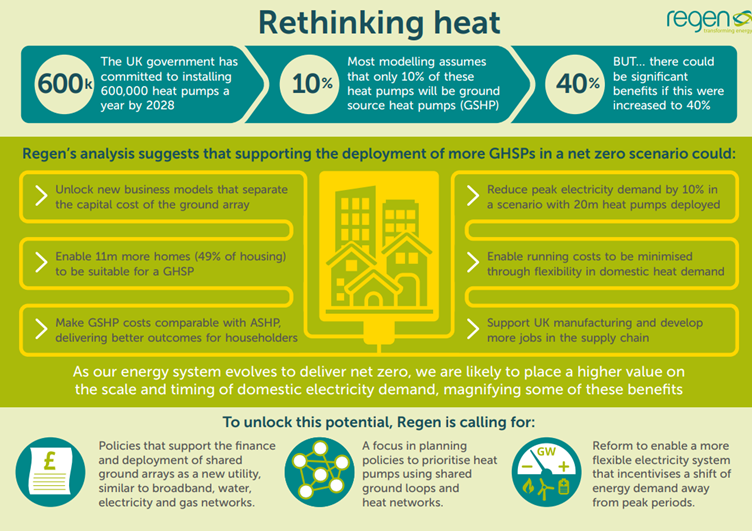
The report argues that choosing the right heat pump technology will be key to delivering benefits to households, as well as mitigating electricity system costs. Policymakers and industry analysts have often focused on air source heat pumps (ASHPs) due to their lower capital costs and reputation for being easier to install, but new installation approaches that share ground array infrastructure could unlock the advantages of GSHPs for more consumers and the electricity system, Regen’s paper suggests.
Johnny Gowdy, Regen director, comments: “The potential role of GSHPs has been underestimated. With a new system design based on shared infrastructure, and supported by a utility-style finance model, GSHPs could revolutionise how we heat our homes and businesses.”
Mark Howard, co-author and project manager at Regen, adds: “The increasing government ambition for heat pumps offers a great opportunity to modernise and decarbonise our homes. This ambition must be supported by policies that allow the heat pump industry to rise to the challenge of delivering better, lower cost systems that consumers prefer to fossil-gas boilers.”
Simon Lomax, CEO of the Kensa Group, says: “This important report from Regen draws attention to the ever-increasing appeal of ground source heat pumps and argues that ‘split ownership’ business models, where the cost of the ground array is divorced from the cost of the heat pump, will allow the technology to compete favourably with air source heat pumps, particularly when delivered on a street-by-street basis.”
The report recommends:
· Policies are introduced that support the finance and deployment of shared ground arrays as a new utility, similar to broadband, water, electricity and gas networks.
· Confidence is provided in the scaling up of demand for GSHP so that UK companies can invest in the opportunities for manufacturing and installation.
· Focus remains on energy efficiency as a key enabler of all low carbon heating solutions.
According to Regen’s analysis, benefits of GSHPs include the potential to reduce peak electricity demand for heat by at least 10% in a high heat pump scenario, and the opportunity for shared ground arrays to further reduce heating costs by utilising local sources of heat to boost heating performance both for new builds and retrofits.
To overcome the higher capital cost of installation, the report recommends that the ground array system be treated and financed as infrastructure which would mean GSHPs could connect to pre-installed shared ground arrays, much like householders connect to a gas or water mains.
The report can be read here.

