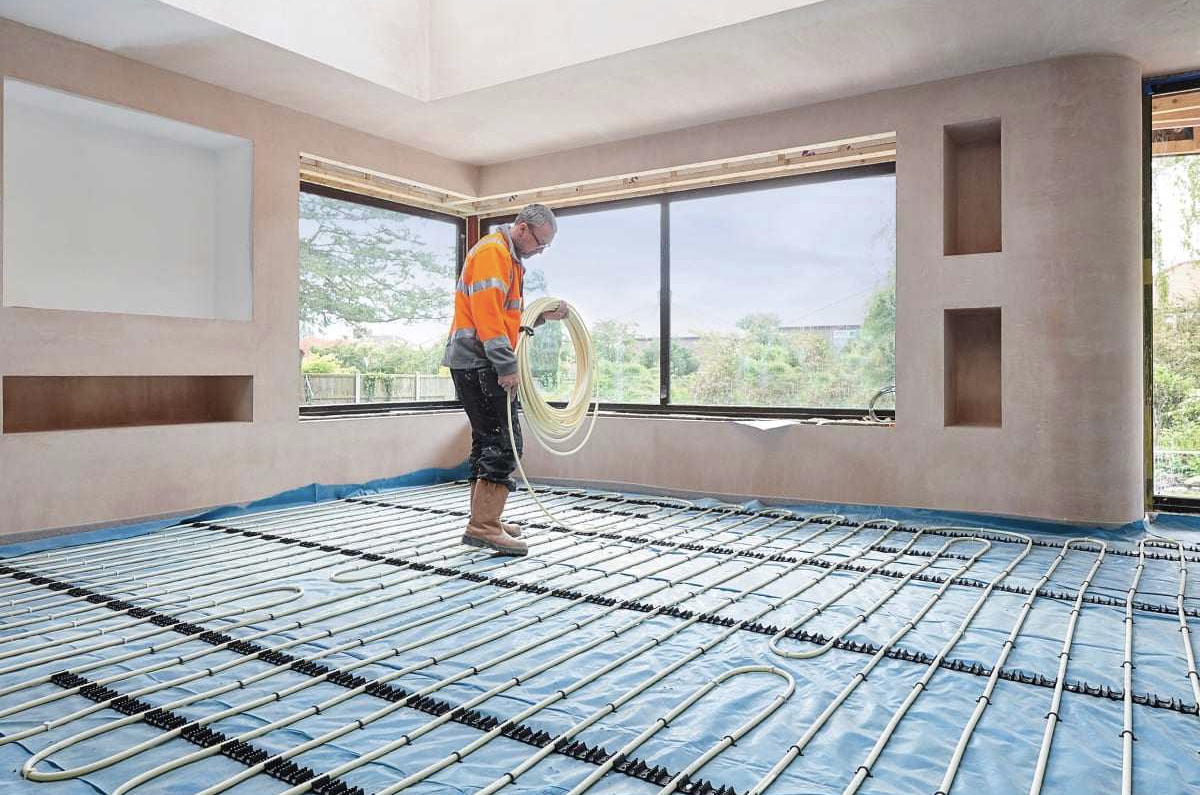
Mario Nash, National Account Manager at City Plumbing, explains why underfloor heating is the key to both sustainable home heating and a sustainable business.
The UK is making huge strides towards a greener future. Plans to significantly reduce emissions by 2030, and ultimately achieve net-zero by 2050, are already starting to influence shifts in how we heat our homes. As a result, underfloor heating (UFH) is surging in popularity in the UK – particularly as homeowners seek ways to reduce monthly bills while making their properties more sustainable.
As around a third of all UK greenhouse gas emissions come from homes, and 80% of that from heating systems, installers can make a meaningful contribution to sustainability efforts by facilitating the shift to low-carbon alternatives such as underfloor heating. In doing so, installers will also be in a position to strengthen their businesses by leading the way to a more sustainable future.
Efficiency and cost savings
Distributing warm water through a circuit of pipes beneath the floor, wet UFH systems can heat a much larger area at a lower temperature than a radiator. Generally operating at around 40-45°C, compared to the circa 70°C of a radiator, operating efficiencies are instantly noticeable with boilers not having to work so hard.
This efficiency translates directly into financial savings for customers. While the initial investment for a retrofit project could be in the region of £2,000-£2,500 for a typical family home, maximised efficiency will result in lower monthly bills and see the initial investment recouped within a few years.
Alongside delivering efficiency and cost savings to customers, installers can support homeowners to benefit from more comfortable and functional spaces. With the heat source hidden beneath the floor, more consistent warmth is achieved across an entire room. Plus, with no need for radiators, wall space can be reclaimed and rooms reconfigured to suit modern styles of living and design preferences.
The role of installers
To get the most out of UFH systems, there are a number of considerations to be made and homeowners will be looking to their installers for advice. Firstly, the existing floor may present problems for installers and lead to specific UFH heating products being selected. For instance, where a concrete base prevents digging down – largely due to budget restraints – or where low ceilings mean customers don’t want to see floor heights raised significantly to accommodate UFH, retrofit panels may present the best option.
At just a max. 20mm deep, retrofit panels can be laid across the existing base surface, with the final floor finish then being laid on top. In practice, this approach supports installers to equip their customers with wet underfloor heating with minimum disruption and without raising the floor level beyond a noticeable level.
Once the UFH system is installed, the next consideration will be around the floor finish which is laid on top. While tiles and vinyl tend to be the best options for maximising the efficiency and effectiveness of the heating system, carpets can also be an option – particularly where a lower combined tog value carpet & underlay are selected, enabling the heat to pass through more easily.
With these options being discussed between installers and their customers, homeowners can be satisfied with the system they choose and the level of comfort it brings into their homes.
Future-proofing
As UFH is capable of delivering consistent warmth at much lower temperatures, it is often considered to go hand-in-hand with renewables. When paired with an air source heat pump, for example, homeowners can operate their UFH much more efficiently and cost-effectively.
For installers, this presents an opportunity to expand their offering and secure their business for the long-term. As gas boilers are being phased out over the coming years and more changes are anticipated across the industry to support the UK’s journey to net-zero, installers should consider preparing their businesses for installing renewable solutions.
To achieve Government ambitions, 600,000 heat pumps will need to be installed per year by 2028. Realising this volume of installations requires installers to undertake training where needed and gain the certifications to successfully install renewable solutions. At City Plumbing we are already seeing an uptake in customer demand for this technology and all predictions point to a huge market growth over the next decade, making for an attractive proposition amongst installers.
To help installers through the process and deliver value to customers who wish to switch to renewables, we have a dedicated team of specialists with more than a decade of experience in renewable technology. As well as recommending the most suitable products for specific applications, the team is also on hand to help installers design and specify renewable systems for their projects.
To find out more, please visit: www.eecityplumbing.co.uk