Chris Stammers from BEAMA explores the key benefits of multi-zone underfloor heating systems and discusses why these solutions have gained traction for installers and homeowners seeking a balance of energy efficiency, flexibility and comfort.
Multi-zone heating enables a property to be divided into distinct ‘zones’ that can be heated independently, providing homeowners with enhanced control over comfort and energy consumption. Each zone can be regulated individually, either manually or through smart controls, ensuring that heating is delivered only where and when it is needed.
Depending on how the homeowner intends to use each space, installers might suggest combining the living room and kitchen into one zone, the bedrooms as another, and the bathrooms as a third. This setup is optimal for enhancing efficiency and providing better control over each area. During the colder months, frequently used spaces like the living room and kitchen can be kept warm and cosy, while the temperature in less often occupied rooms – such as home offices that go unused on weekends – can be lowered, helping to reduce energy consumption and lower heating bills.
UFH in zoned systems
Hydronic (water-based) underfloor heating (UFH) is well-suited for multi-zone heating, as it operates through separate, independently controlled zones. These established capabilities of UFH have brought the solution into the spotlight, and the technology complies with evolving regulations like Part L and the upcoming Future Homes Standard.
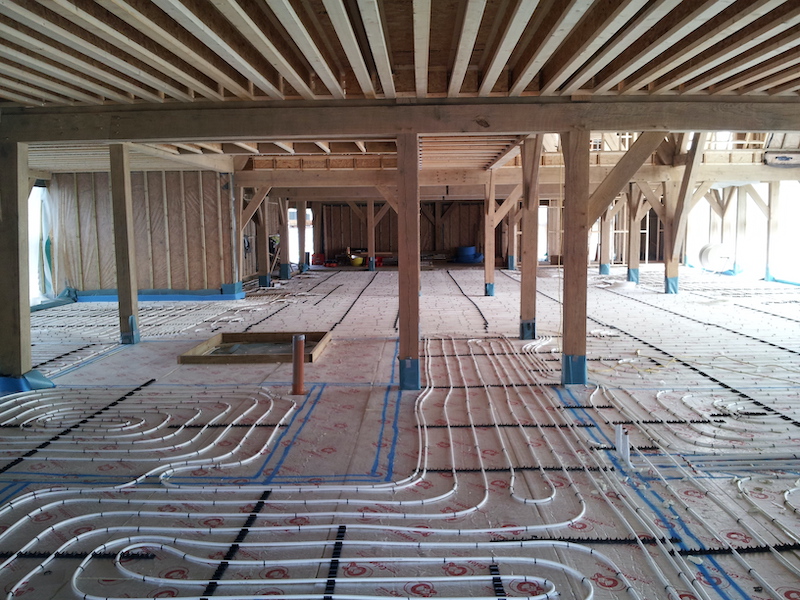
Ideal for new builds and major home renovations, hydronic UFH systems naturally accommodate a multi-zone heating configuration. This is achieved through a series of interconnected pipe circuits arranged in loops within the subfloor, with each loop connecting back to a central manifold. Underfloor heating manifolds can simultaneously manage multiple zones, allowing each area – or room – to be heated to a different temperature based on the user’s preferences.
Numbers don’t lie
Effectively, UFH converts the floor into a large heat emitter; heat is evenly distributed across the surface, helping to maintain a comfortable ambient temperature in every space. This stable and consistent air temperature promotes more efficient system performance and enhances overall comfort.
Recent research from Salford University’s Energy House 2.0 demonstrated that hydronic underfloor heating (UFH) excels at maintaining consistent temperatures throughout each zone. The study recorded minimal temperature variation, only 0.8°C at -5°C and 0.7°C at +5°C when operated using a standard SAP heating pattern. Traditional radiators showed a minimum variation of 2.2°C, while other systems displayed differences of up to 4°C. Even greater consistency was achieved when UFH was running continuously.
These results also emphasise UFH’s advantage when combined with air source heat pumps (ASHPs), delivering efficient, evenly distributed heat throughout the home. The low-temperature, radiant heating method boosts energy performance, enhances long-term occupant comfort, and assists in meeting low-carbon building standards.
In control
Controls are vital for the efficient functioning of any UFH system and should always be a top priority when specifying and installing. Recent regulatory updates also request that new systems in homes with a floor area of 150m² or more include at least two independently controlled zones, necessitating smart or thermostatic controls.
Efficient controls allow precise regulation of heating output and temperature levels in a zoned system, enhancing user flexibility and minimising energy waste. Because UFH is naturally designed and installed in zones, integrating controls is straightforward and can be implemented as it has traditionally been.
While ensuring that the chosen heating system is highly energy efficient is essential, only half of the benefits may be realised if the system is not combined with an advanced intelligent control system. Smart controls enhance a heating system’s performance, helping to prevent energy waste and consequently reduce its operating costs.
Precise design
Additionally, a high-limit thermostat should be installed in the UFH distribution system if the heat generator can provide water temperatures exceeding 60°C. A well-designed zoned system enables the end user to create distinct temperature zones, each with personalised settings that can be adjusted and monitored from the thermostat or smartphone app, ensuring comfort and energy savings.
For any project, precise system design is crucial to ensuring the desired heat output is achieved and that the finished system meets the end user’s expectations. Collaborating with a specialist supplier who can offer expert knowledge – whether by providing initial CAD system designs, heat output and heat loss calculations, and controls, or technical and after-sales support – is invaluable for the success of any project. This support assures installers and customers that the system will deliver optimal performance from the outset and well into the future.