With the UK having just navigated the hottest summer on record, water efficiency is something all of us are having to think about more carefully. Here Stuart Reynolds, UK marketing & product management director at AKW discusses new water efficiency standards, what they will mean for installers and specifiers and how compliance can be achieved, while delivering long-lasting traditional and accessible bathroom installations.
The Government’s proposal to tighten and expand existing water-efficiency requirements has been driven in part by a desire to remove new home building barriers in water-stressed regions. This has meant that the Department for Environment, Food and Rural Affairs (DEFRA) is now aiming to meet legally binding goals under the Environment Act that will reduce public water supply user per person by 20% by March 2038.[i] And this is already having an impact on both traditional and inclusive bathroom design.
Key specifications from the plan include:
- Tighter Part G Limits: Mandatory minimum standards for new homes are shifting down to 105 litres per person per day (l/p/d),[ii] and dropping to 100 l/p/d (the optional technical standard) in water-stressed regions.
- Mandatory Water Efficiency Labelling Scheme (MWELS): Due to come into force by the end of the year,[iii] this planned rating system scheme on high-consumption products like WCs, taps, and showers will make verified flow and flush rates legally transparent at the point of choice.
- Fittings-Based Caps & Outlets: The shift toward high-resolution Home Energy Model (HEM) compliance will mean individual hot water and flow outputs for taps and showerheads will be under increasing scrutiny.
- Baths and toilets: Standard luxury large-volume baths and single-flush or heavy dual-flush toilets will become a thing of the past, in favour of more compact configurations, air-powered/aerated fixtures, and smart dual-flush mechanisms.
Performance as well as aesthetics
Where in the past fitting and fixture specification was largely down to aesthetics and price, water efficiency will soon become an additional factor for consideration, thanks to MWELS. What this will mean is different for each area of the bathroom:
Toilets – Those with standardised dual flushes and gravity-fed flushing technology will achieve ‘A’ ratings. Large-volume flushes will be lower rated than low-volume dual flush cisterns (e.g. 4/2.6 litres or less), so that water use is minimised per flush. Also, as the label rates the pan and cistern as one, random mix and match pairings will mean risking a lower, uncertified efficiency tiering.
Taps – Litre/minute flow rates will define the taps efficiency rating, meaning that standard open-spout taps will see a decline, compared to their more efficient aerated counterparts. Integrated aerators and flow regulators that achieve a 5-6 litre/minute flow will become increasingly popular.
Showers – Not surprisingly, high-flow deluge heads that have a flow rating of 12-15 litres/minute will have efficiency ratings of ‘E’ or ‘F’, so air-injection and pulse technology solutions will gain ground. And, because the MWELS rating data will tie directly into whole-house compliance software, the specification of Class ‘A’ showers will make it significantly easier for specifiers to clear overall development water thresholds.
Which appliances to focus on
The direction of change is clear. Water efficient products are becoming the new norm. So here are some things to consider when looking to install more water-efficient general and accessible bathroom products:
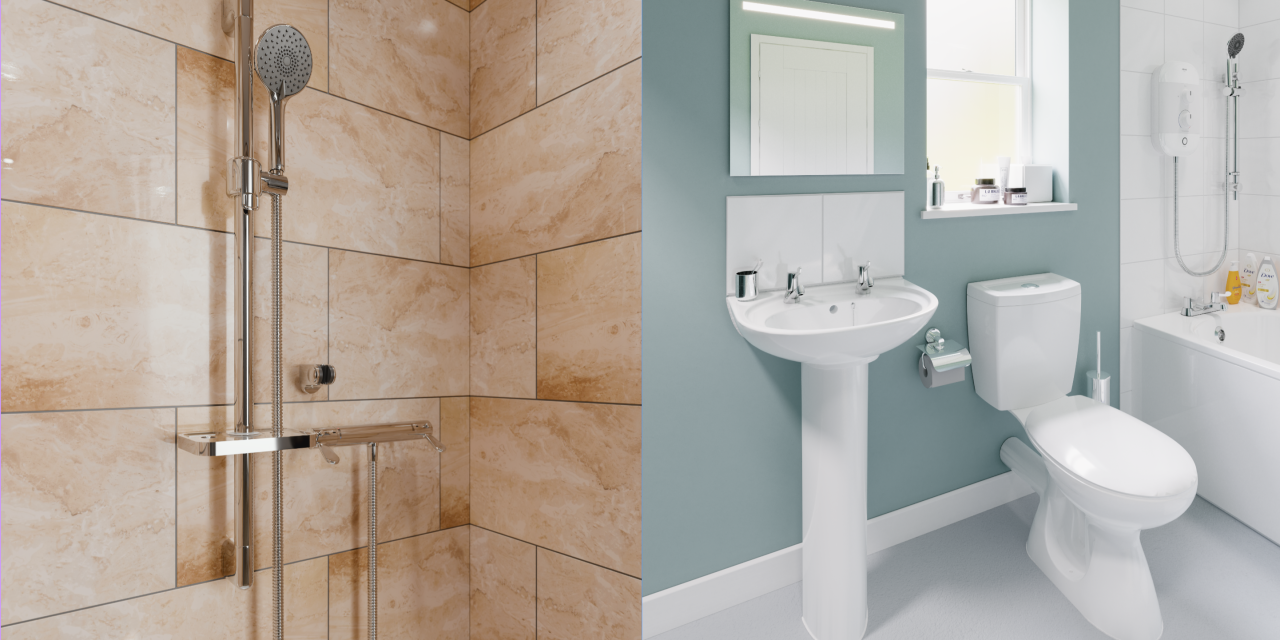
Showers – When it comes to energy- and water-savings in bathrooms, installing a reduced or variable flow electric unit that has different flow options makes sense, as it can be more cost effective in terms of the water saved over the shower’s lifespan. AKW’s WRAS approved flow limited showers help achieve impressive water savings, as well as promoting safe, reliable showering. Also, AKW’s SmartCare Plus, SmartCare Lever and iTherm electric care showers all come with an eco-default setting (which can be over-ridden if needed) that limits flow rate to 6 litres per minute.
Toilets – Dual-flush models can save a significant amount of water over the many years they are functional and AKW’s Livenza Plus close-coupled toilet comes with a 3/6 litre flush option.
Wash basins – The deeper the wash basin, the more the user is tempted to fill it. AKW’s Livenza Plus basins are smaller than standard wash basins, offering 62% less volume than AKW’s largest one, allowing for significant water saving potential. The basins can also be specified with wheelchair friendly semi pedestals too.
Bidets – it might seem strange to include bidets in a water saving discussion, but a bidet uses approximately 0.2 litres to 0.5 litres of water per use, compared to a toilet that uses anything from 3 litres to 13+ litres for an older model. Also, it replaces the need for toilet paper, which is a water- and energy-intensive item to produce.
Water-efficiency is here to stay, and there are a wide range of stylish accessible and general bathroom products already on the market to meet the changing regulations. So, is it time to upgrade your product knowledge, making sure you are equipped to juggle present and future shifts in regulations?
Find out more
For more information on how AKW’s can help you save water and money vist: https://akw-ltd.co.uk/document/water-energy-cost-saving-guide/
[i] https://www.gov.uk/government/news/water-efficiency-must-become-national-priority-says-ea
[ii] https://consult.defra.gov.uk/water-efficiency-demand/review-of-water-efficiency-standards/?utm_source=chatgpt.com
[iii] https://www.gov.uk/government/publications/water-demand-environment-act-target-delivery-plan/water-demand-environment-act-target-delivery-plan