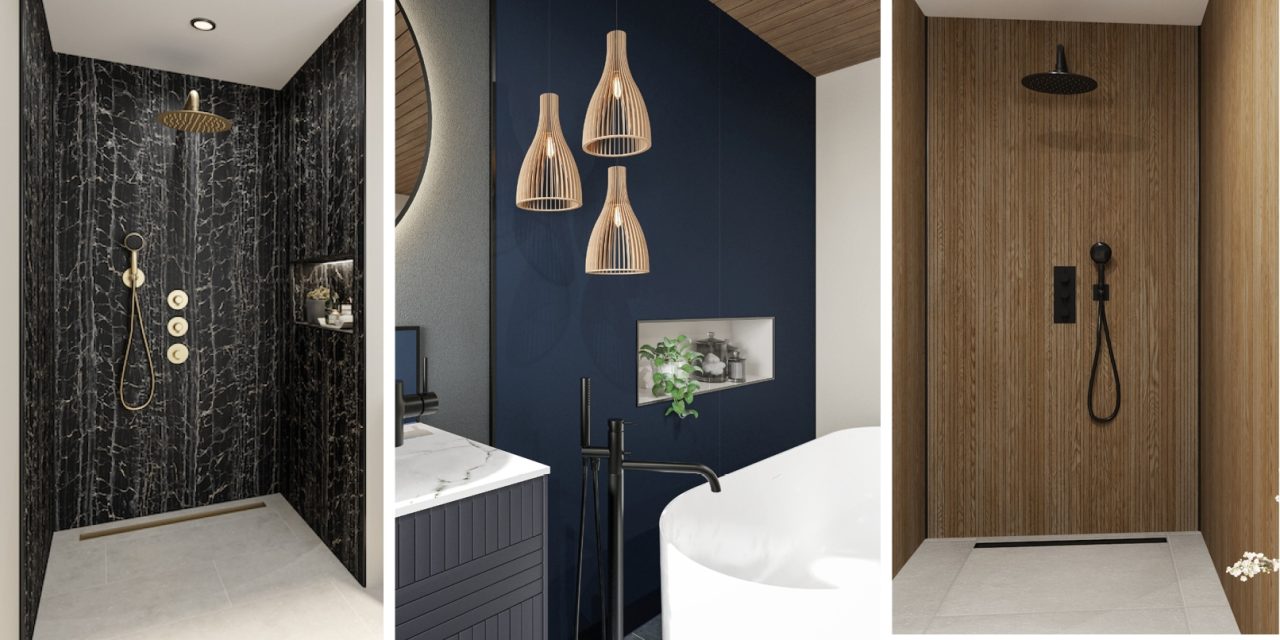
Wall panels are now an essential part of the modern bathroom installer’s toolkit, offering a faster, lower-maintenance alternative to traditional tiling. While size, décor and finish are key considerations, panel thickness is often overlooked. More than a simple measurement, thickness reflects a panel’s substrate, construction and performance, helping installers select the right product and giving homeowners greater confidence in their choice. As Joanne Mailen, product lead at Wetwall, explains, understanding thickness can help homeowners navigate different panel formats and performance characteristics, enabling more informed decisions.
The truth about panel thickness
There is a common assumption that thicker panels automatically deliver better performance. While that may have been true of some early wall panelling products, modern bathroom panels are engineered very differently.
Today, thickness is determined by the panel’s construction and intended use rather than being a straightforward indicator of quality. Manufacturers carefully balance factors such as rigidity, weight, handling characteristics, joint design and installation requirements to achieve the desired performance. In that sense, thickness is an engineering decision, reflecting the capabilities of the substrate and the intended application rather than simply indicating strength.
It’s what’s on the inside that counts
Regardless of thickness, all modern bathroom wall panels are designed to achieve the same goal: providing a durable, waterproof and decorative finish when installed correctly. In practice, waterproof performance is influenced far more by the panel finish, joint design and installation system than by the thickness of the core itself.
Advances in manufacturing have also expanded the range of substrates available. Alongside traditional wood-based panels, engineered materials such as mineral polymer composite (MPC) and aluminium composite offer distinct performance benefits, enabling manufacturers to produce slimmer, lighter panels without compromising durability.
As a result, thickness should be viewed as one element of the overall specification rather than the defining measure of a panel’s performance.
Panel thickness in practice
Where thickness can make a difference is during handling and installation.
Slimmer panels might be favoured for refurbishment projects because their reduced profile makes them particularly well suited to over-tiling applications and projects where existing baths or shower trays are being retained. They can also help minimise the amount of floor space lost within smaller bathrooms.
Similarly, substrates like MPC are manufactured with high inherent stability, allowing them to achieve impressive rigidity in slimmer profiles which can make handling far easier on site. No breaking your back as you manoeuvre the panel into position.
Thickness can also represent how the panel will behave during installation. For example, wood-based substrates, such as MDF or plywood, typically require a thicker profile to deliver the rigidity needed for larger formats and to accommodate machined features like tongue-and-groove joints.
An MPC core would have a slightly slimmer profile than a timber-core which would still allow for a tongue-and-groove joint but can also support a curved, post-formed edge which cannot be achieved on a wood-based panel. This curved edge is a distinct advantage over traditional wood panels as it completely removes the need for visible trims.
In practice, thickness is simply the visible outcome of how a panel is built. By understanding the characteristics of each substrate and how construction influences thickness, installers can more easily explain the differences to homeowners and select the most appropriate format for each project.
Specifying for the space
As is so often the case, choosing the right panel is ultimately about understanding the demands of the project rather than focusing on thickness alone.
When making a recommendation, installers should consider factors such as the installation method, substrate condition, room layout, project timescales and customer expectations. A slimline panel may offer significant practical advantages in one installation, while a thicker engineered panel may provide additional benefits through enhanced rigidity, integrated jointing systems or trim-free design options in another.
There is no universal ‘best’ panel thickness. Every substrate has been developed with a specific application in mind, and the most successful installations are those where the specification matches the requirements of the project.
For more information about Wetwall visit wetwall.co.uk.