
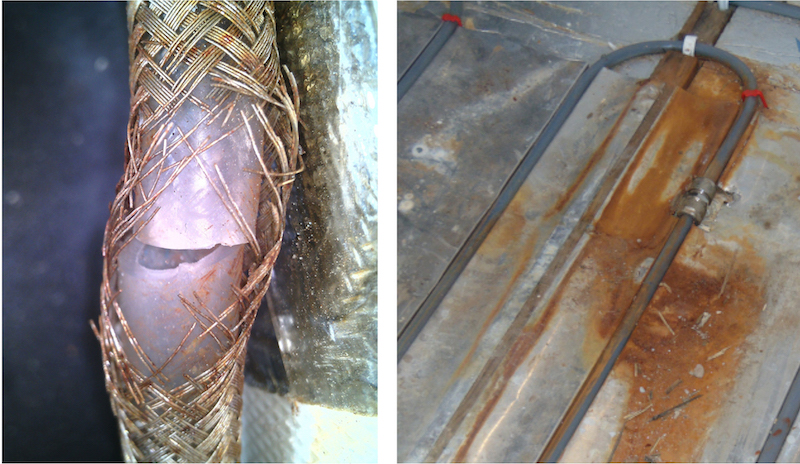
Most people will be familiar with police forensic investigations thanks to some popular films and TV programmes, but forensics is not unique to law enforcement and has an important role in engineering. Carol Hitchcock, assistant editor for PHAM News, talks to consultant investigator Alexander Wildish.

Imagine waking up one morning to a call from a client who’s panicking because their basement is filling up with water just a few weeks after you installed a new piping system in their well-appointed home. Your first move might be to stop the deluge and call your insurance provider. But what happens after that?
In a case like this, where damages could run into the tens of thousands, everyone involved is going to want answers. Somebody has to pay for it, and it could be you. But what if it’s not your fault? What if you did everything by the book and responsibility lies with the manufacturer who supplied defective product, or with another trade who meddled with your work? How will you know?
If that flooded basement were a crime scene, a police forensic examiner might come in to collect evidence, investigate materials and test it all in a lab. It’s not so very different in cases of plumbing and heating installations gone horribly wrong, except the people who show up to investigate are forensic engineers. While they probably won’t dust for prints or take DNA swabs, forensic engineers have a similar aim to their police counterparts as they seek answers in the evidence left behind.
This is what Alexander Wildish’s firm, Engineering Forensics, does. As a consultant investigator of mechanical engineering related incidents, Alex has investigated everything from pipework failures to gas explosions and drilled down to the root causes using science. With a master’s degree in mechanical engineering and a wealth of experience from working with the Ministry of Defence and Metropolitan Police in forensics roles, Alex has a specialised skill set that can help solve the mysteries behind plumbing and heating disasters.
CSI of the plumbing world
Alex founded Engineering Forensics in 2015 and now works with a team of four forensic experts to offer clients advice on everything from escapes of water and oil, to fires and explosions, to mechanical failures. Much of their activity takes place in their in-house laboratories where they examine evidence from every conceivable angle, right down to the atomic level using an electron microscope.
“We are bit like the CSI of the plumbing world,” he says. “Our objective is to explain how engineering failures occurred by analysing materials. It may be clear what happened – a flood, for example – and why it happened – maybe a burst pipe – our job is to prove how it happened from a scientific point of view. It could be a problem in the design of the system, or a product defect, or poor installation.”
Most installers will never find themselves in need of Alex’s services. When something doesn’t go to plan on a job, you can usually figure out where you went wrong by doing your own fault finding, and more often than not the only loss will be a bit of your time. Forensics comes into the picture when there has been significant damage to your customer’s property and your professional indemnity insurance suddenly seems like a good investment.
Going back to the hypothetical flooded basement above, an installer on his own probably won’t be able to arrive at a definitive answer of what went wrong, at least not one that will satisfy the insurer who has to pay the claim. Alex explains why a scientific viewpoint is needed in a situation like this:
“Let’s say that the flooded basement had a number of compounding problems. Failure analysis will take in all aspects of the installation – the pump set, joints, tubing, and so on – but also the broader circumstances. What if there were a swimming pool and jacuzzi on the property and there had been heavy rain in the period leading up to the incident? We’ll also look to see if the installer followed British standards and regulations.”
Once the scene has been surveyed and witnesses interviewed, the collected evidence goes back to the lab with Alex where he and his colleagues can analyse the suspect materials. Tubing can be looked at to identify any flaws in its make up, pumps tested for manufacturer defect, and compression joints examined to determine how well they were made.
At the end of it, Alex writes a report of his findings for the client (usually an insurer), and this ultimately ends up in the litigation process. “We interpret the evidence for the court so it can rule on disputes involving engineering questions,” he says. “The report assists the judge in reaching a fair decision on which party pays damages, and how much.”
Plumbing can be a risky business, which is why any good installer will have indemnity coverage, and sticking to the rules and regulations can go some way in reducing the professional risks. However, too many perfectly competent plumbers are not adhering to the regulation that requires pressure testing.
According to Alex, failure to perform this procedure comes up far too often in his investigations. “What we often see in cases where a fitting has failed is that the plumber didn’t test the pipework according to regulations and manufacturer’s instructions,” comments Alex. “It’s rare to encounter a plumber within the scope of an investigation who says ‘I pressure tested my work properly and here’s my certificate to prove it’.
“WRAS guidance says plumbing installations and fittings should be pressure tested at 1.5 times the maximum working pressure,” he adds. “Reliably doing this can prevent problems from happening down the road. My advice is to be methodical and follow the regulations. It won’t completely eliminate problems, but it reduces the likelihood,” he says.
Alex has a lot of praise for plumbers in the field – he himself has a City & Guilds qualification in plumbing and is also the son of a gas fitter. “Plumbing installations happen across the country thousands of times a day, and by and large they go without incident,” he says. “Most people are doing a good job and take pride in their work. But there are the small few jobs that go wrong.”
Copper or plastic?
Pipes and joints are of course a common target of investigation in plumbing failures, and one might wonder if there is greater incidence in copper or plastic installations.
“From a forensics perspective,” explains Alex, there is no difference between copper and plastic. Both materials are sound, and both can be subject to manufacturing defects. A lot of plumbers will favour copper for their own reasons, but it’s not immune to problems if you are using defective solder or making insufficient compression joints. Plastic tubing is long-lived, standing up to 50 years and more of service – products made by John Guest and Polypipe are really good.”
He adds that between defective products and defective installations, the latter is far more common in plumbing failures. “We do come across manufacturer defects, but more likely than not it’s an installation error,” he says. “We investigate 15 to 20 cases a month, and we only find manufacturing defects two or three times a year.”
When it comes to fires and explosions related to gas installations, the ratio changes significantly. According to Alex, it’s an even split among faulty parts, installation error and an appliance simply being pushed beyond its service life.
“Because of stringent regulations and the training gas fitters have to go through, there seems to be a greater duty of care in this area,” Alex observes. “If something goes wrong, the consequences could be extreme, or even result in fatalities. That really focuses the mind.”
Backing the Institute
While the Gas Safe Register exists to protect the public from unsafe gas work, there is no equivalent regulatory body overseeing plumbing. This is one of the reasons that Alex is a strong advocate of the CIPHE, where he is a Fellow and serves on the elections committee.
“I can only speak highly of the CIPHE,” concludes Alex. “To join the Institute, plumbers and heating engineers have to prove their qualifications and keep them up to date. We very rarely investigate plumbers who are affiliated with the CIPHE. They are less likely to cause a problem because they undergo continuing professional development to maintain their qualifications and the Institute checks their records. Plumbing and heating is a skilled profession that requires a lot of technical expertise, so you have to keep learning.”
Nobody wants their work inspected by a third party, least of all by a forensic engineer, but the good news is if you are competent and carry out your work to best practice and adhere to the regulations, you’re unlikely to ever meet Alex or anyone of his ilk. Best advice? Don’t cut corners, use high quality materials, and always aim for a job well done.
