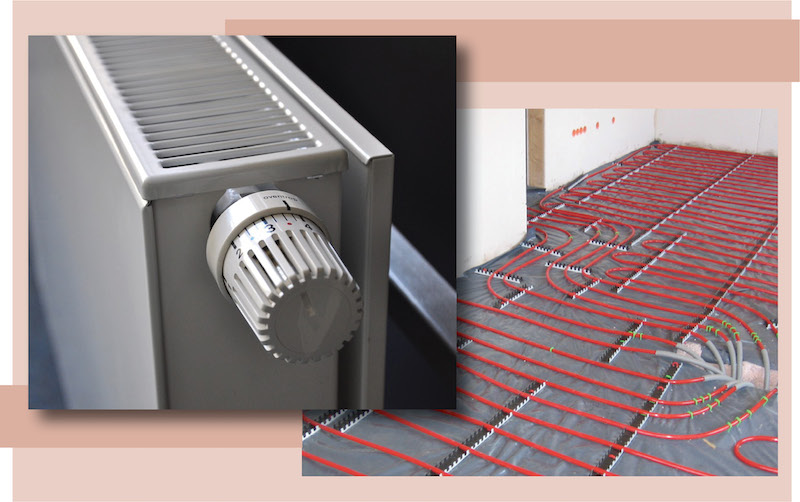
The experts at Underfloor Heating Trade Supplies explore the synergy between two very different heat emitters.
It may feel daunting to be asked to add an underfloor heating system to a house that has radiators. Even more interesting for the installer is the client who is happy to have underfloor heating in certain zones of the house but desires radiators in others.
The good news for you and your client is that choosing to run both systems is not only possible, but it works well. Both wet underfloor heating and radiators can work from the same boiler. You do also have the option of the two approaches working from two independent systems. The key takeaway is that you have a lot of flexibility.
Why might you advise a client to choose both?
When discussing the heating requirements with a client, whether it is a new build or a renovation, they will be concerned about budget. Choosing an underfloor heating system for the whole house can be expensive. When renovating, the necessity to lift some floors might be too disruptive. You will want to make sure your customer has the right floor and floor covering to make the most of the underfloor heating. They may be unwilling to take these steps.
Most clients will have ideas about where they would like underfloor heating. Most see the value in the bathroom, where they can walk onto tiled or laminated floors without fear of cold rushing into their toes. However, the same client may want plush carpets in living areas, which makes underfloor heating redundant. Therefore, for this client, the option to go for this dual approach is advisable.
The options
You have ultimate flexibility when it comes to combining the radiators with the underfloor heating. However, the configuration of such a system will rely on whether your client opts for wet or dry underfloor heating. Choosing wet underfloor heating can be expensive but as it can run off the existing boiler and may well be the most cost-effective in the long run. A dry system will run entirely independently to the radiators, as it uses wiring and pads as opposed to underfloor pipes. This is much more convenient but more costly and potentially more complex for the client to manage alongside radiators
Choices when renovating
When renovating the home, the crucial decision is about whether to raise the floors to accommodate the wet underfloor heating system. If the client wants a system that runs from the same boiler, then you will have no choice but to choose the wet system. You will then need to seek all the permissions for what can be the significant construction.
Equally, the client may find the construction costs involved prohibitive and choose to retrofit underfloor heating only in individual rooms. In this scenario, it may be more appropriate to suggest using a dry underfloor heating system. If dry underfloor heating is only used for some places, such as bathrooms or the kitchen, then it can be cost-effective to run in the long term. A whole house of dry underfloor heating would send electricity bills soaring.
Choices for a new build
In truth, there seems little point in mixing the two systems when you are completing a new build. Underfloor heating throughout adds that added element of luxury and so boosts the final price of the home, with only a small investment.
If the client makes a case for using radiators and underfloor heating, then the best choice is a wet system. This choice will allow you to run both heating methods from the same boiler.
Keeping the two systems independent using a zone valve is both easy to install and easy for the client to operate. The zone valve will put the customer in complete control of the running costs of the heating system.
Using a zone valve allows you to limit the journey of the water around the system.
As you are aware, the wet system works by sending hot water from the boiler through the pipes beneath the floor. When the water flows back into the system, a temperature sensor assesses if the water is still warm enough if so it will be recirculated around the parts of the house requiring heating. Only if the temperature has dropped will the boiler kick in to create more hot water. Therefore, by reducing the length of the journey of the water, the more efficient the system runs.
The radiators and underfloor heating will work independently in this regard, as there is a sensor attached to the manifold in the underfloor heating that will detect a drop in temperature. Therefore, even though connected to the same boiler, the temperature in the radiators and the underfloor heating can run independently.
How to advise your client
You can offer your client choices. It is possible for the client to precisely control the heating in each room independently. It is also possible to work to a relatively limited budget. It is essential when discussing with a client the long-term costs of running the heating system, as well as the initial cost of installation.
For more information visit Underfloor Heating Trade Supplies