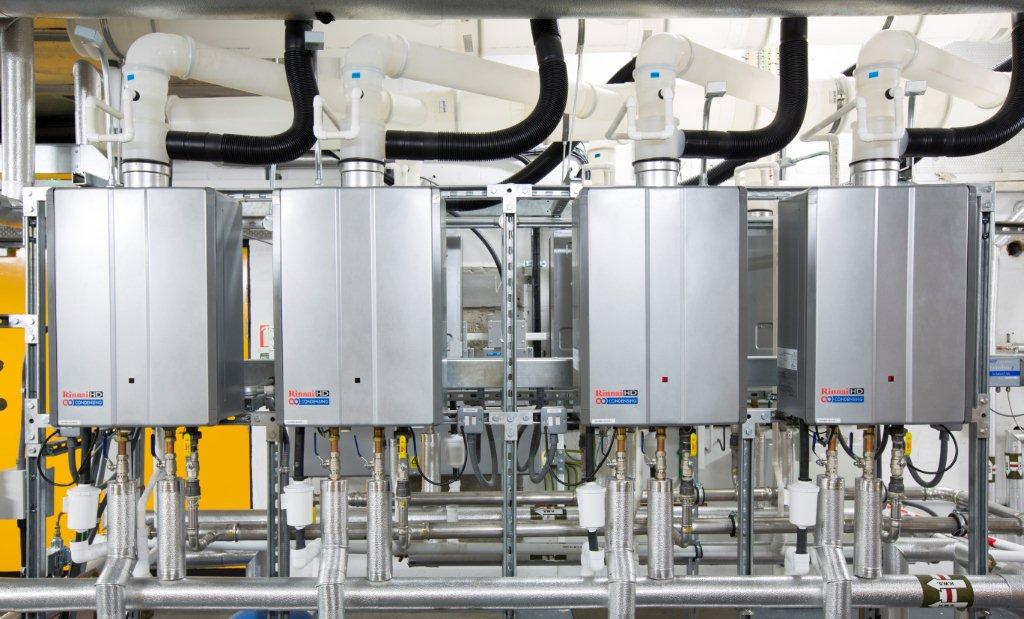
Continuous flow water heating systems can be up to 7% more economical than equivalent traditional stored hot water systems according to an independent study carried out by AECOM. Rinnai commissioned the building engineering services consultancy to carry out a life cycle study over 20 years on continuous flow water heating systems, and to provide a comparison with conventional storage systems.
The research team was commissioned to carry out a life cycle study on continuous flow water heating systems, and to provide a comparison with conventional (direct and indirect fired) storage systems. Two case studies were provided that are based on projects using continuous flow water heating systems. AECOM then determined an equivalent storage based system for each case study and compared operational and capital costs.
For the life cycle comparison, the analysis period was 20 years, based on the expected service life. The net present value (NPV) calculation is based on a discount rate of 3.5%, an inflation rate of 2% for servicing costs and projected retail fuel costs from DECC. Researchers determined that in both case studies the continuous flow system showed a clear advantage in terms of initial capital costs, as well as life cycle costs over 20 years, with the continuous flow system consistently lower in energy use than the two storage systems.
The first case study was modelled on a small, pre-fabricated fast food restaurant. It is assumed the system only serves the hot water demand. Taking into account the assumptions regarding initial capital costs, projected annual fuel costs and estimated servicing costs, the resulting net present values of the three showed that the continuous flow system is 6 to 7% lower than the two storage systems based on that 20 year analysis period.
The second case study analyses a system for a shower block in a holiday camp, with six showers and four basin taps. For the continuous flow option, the analysis is based on a configuration of four continuous flow water heaters that each have a nominal output of 48kW. For this particular application, because there is a very short run of pipework between the water heaters and the fixtures, it is possible for the water heaters to generate water at 40°C. The risk of legionella is overcome by regular system flushing.
For the energy required to deal with the instantaneous hot water demand, the analysis assumes that the bulk of the hot water demand would be due to the showers. Each shower would typically have a flow rate of around 9 litres per minute, which if mixed to 40ºC would equate to an instantaneous load of around 19kW each, so even if there was only one shower running, the load on a single continuous flow water heater would equate to an efficiency of 95% based on the performance curve.
As the hot water demand increases, the modular nature of this particular configuration would allow the 95% efficiency to be maintained for the bulk of the demand.
The difference in daily fuel costs between the three systems is around 7%. The usage profile for this case study is particularly suited to continuous flow systems, which allow for high but infrequent demand over the day.