Air conditioning systems often force a compromise on aesthetics, with bulky indoor units on show in rooms. Rinus Groenewald, Technical Manager with Unico System distributor Quantum Group, explains how to achieve a discreet alternative.
Homeowners and small businesses are increasingly expecting higher standards of comfort, in both summer and winter. For many, the traditional options of using a wet central heating system to keep warm in the winter and opening windows in the summer are no longer acceptable.
At the same time, many building owners are keen to take advantage of low carbon technologies such as reverse cycle heat pumps for both heating and cooling. When they go down this route, though, they often find the need to mount indoor units forces a compromise with their carefully chosen décor.
The ideal alternative in these situations is small duct heating and cooling systems. The benefits of such systems include minimal visual impact within the conditioned space (compared to conventional air conditioning), low noise operation and efficient comfort control with excellent temperature distribution.
Also known as small duct high velocity systems, they use a central air distribution system, supplied with either cooled or warm air by a choice of energy sources that include reverse cycle heat pumps, boilers and chillers. They can also be used in bivalent mode with mixed sources (e.g. a heat pump backed up by a boiler). If required, they can be fitted with fresh air input for ventilation.
The central air distribution system delivers conditioned air to small, discreet outlets in the conditioned spaces. As a result, the only visible elements in the conditioned spaces are small circular or slotted outlets. A flush mount circular outlet is also available, which is plastered in so that only a 50mm aperture is visible. The slotted outlets can be configured to create single linear slots.
This discreet end product was essential for the refurbishment of a high-end apartment in London’s Belgravia. In this project two small duct heating and cooling systems were installed in the loft space with main ducts running to each of the four floors. The only visible elements in the rooms are the 50mm supply outlets.
As the interior designer for the project, Rod Pyke of Blue Interiors comments: “To see a design on paper is one thing, to actually fit it in and not see it is another. The supply outlets fit seamlessly into the space and the response of the system is extremely quick and impressive.”
How it works
Conditioned air enters the space through very small jets, creating negative pressure and entraining room air at the outlet with minimal noticeable air movement. This entrainment of room air results in even temperature distribution and compares favourably with cassettes and wall-mounted air conditioners, radiators and underfloor heating. The system can be designed with outlets blowing down or horizontally from high level, or even at floor level blowing upwards, with no discernible difference in heating or cooling performance.
Small duct heating and cooling systems are highly controllable so they can respond quickly and efficiently to changing conditions. Demand-controlled EC fans are combined with soft start and ramp down of the fan motor and the option of inverter driven heat pumps.
Each system will have a room thermostat or, in the case of zoned systems, there will be multiple room thermostats. The fan speeds are usually programmable to match the thermostat demand and automatically ramp up or down as dampers open and close on zoned systems.
Thermostat options range from basic digital units through to wifi-enabled smart thermostats that can be remotely controlled from a mobile device or computer. These systems can also be integrated with most building management systems.
Less noise
Although air is introduced at high velocity, noise levels are low thanks to high levels of acoustic attenuation in these systems. Typical sound power levels of around 29 dB(A) may be achieved. This is better than the current night time target for bedrooms by BS 8233:2014, ‘Guidance on sound insulation and noise reduction for buildings’.
Noise levels were certainly a consideration for the refurbishment of an ambulance control centre in Lewes, Sussex, where operators need to focus on their calls. Here, three small duct heating and cooling systems were integrated with heat pumps and heat recovery to provide a complete demand-controlled HVAC solution. To minimise installation requirements, heating, cooling and ventilation are all delivered through the same acoustically lined ductwork system.
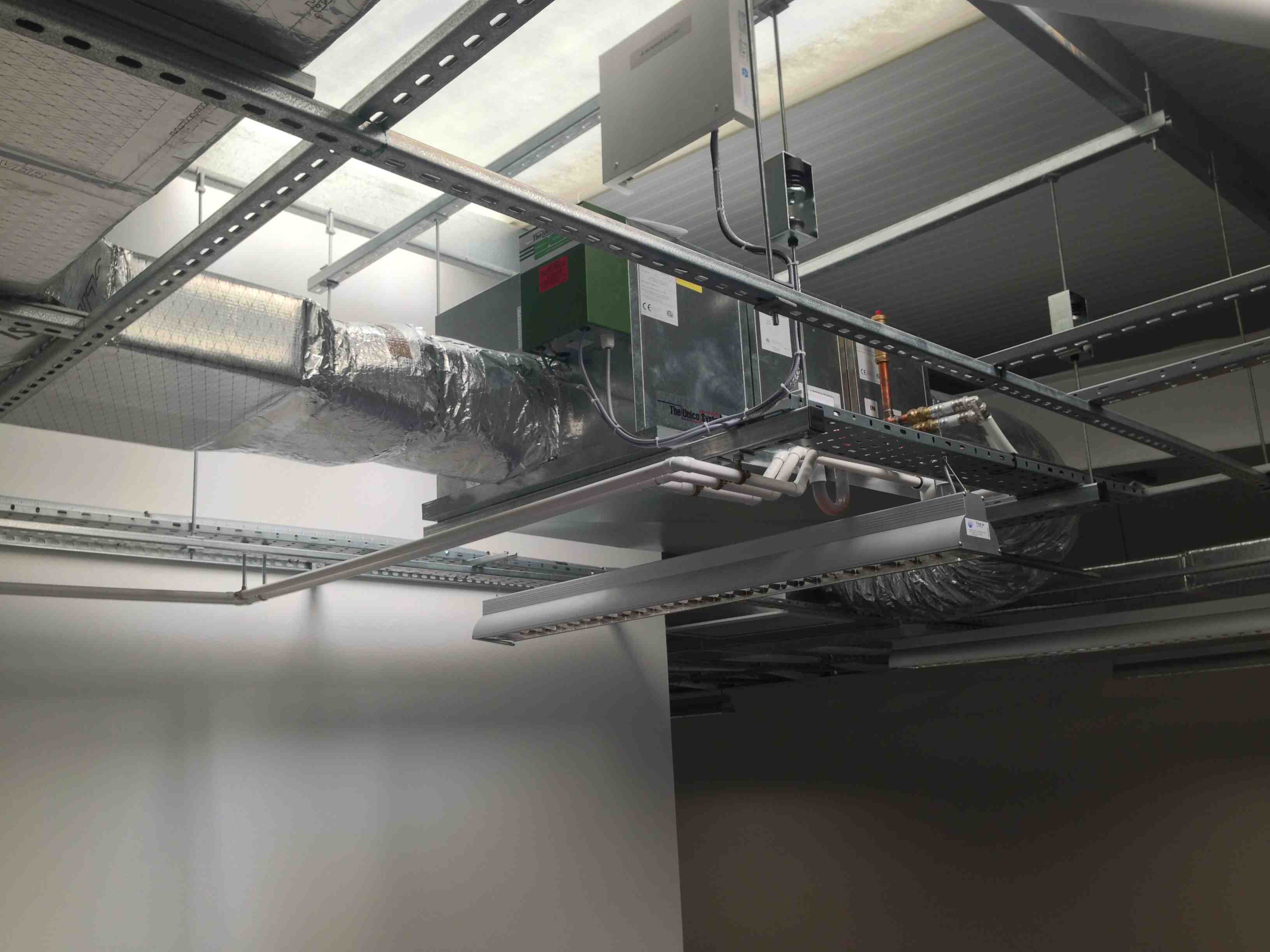
In fact, these systems are relatively easy and quick to install, while the use of centralised plant makes maintenance very straightforward. At the heart of the system is an air handling unit (AHU), available in vertical or horizontal configurations to suit the space. In a residential project this would usually be the roof space or utility room. Most units are modular to allow different configurations and include a blower module, refrigerant coil module or water coil module for use with chillers, boilers or heat pumps and fresh air input modules.
Air movement
Air is distributed from the AHU through a main plenum at a reasonably constant static pressure of around 300Pa. The main plenum is available in a rectangular section, 150mm high for reduced ceiling spaces, and incorporates acoustic insulation to provide attenuation of up to 5dB per metre. The main plenum can be branched off to serve multiple spaces – controlling each room individually with motorised dampers.
From the main plenum, or plenum branches, air is distributed into small flexible ducts with 50mm internal diameter and 90mm external diameter. Each of these flexible ducts then connect to an individual room outlet using simple crimp connections. As with the main plenum, the flexible ducts are pre-insulated to reduce noise levels even further.
Each system has a return air filter, with various grades of filtration available. Return air is usually ducted back to the AHU, or alternatively the system can use a ‘wild return’ with the filter on the back of the unit.
When homeowners and businesses make a significant investment in interior design they don’t want to devalue it with intrusive indoor units. That makes small duct heating and cooling systems the ideal alternative without compromising on performance.