
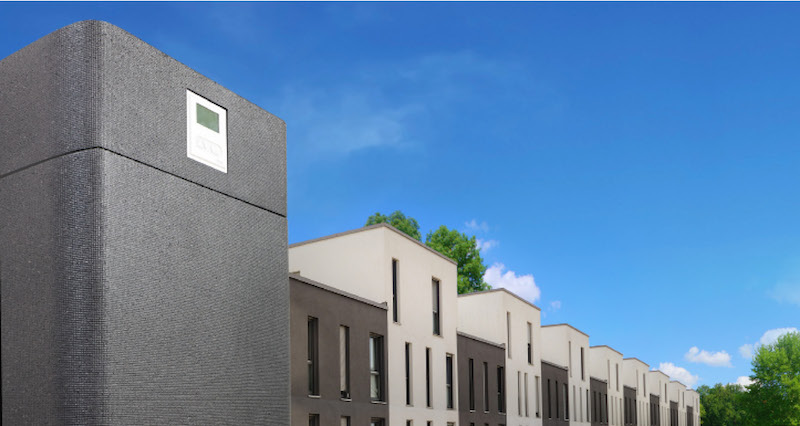
District heating is an increasingly popular solution for large-scale residential and commercial developments. Jonathan Moran from Warmafloor says that it’s important for engineers to educate themselves about the next big thing in heating.
Bolstered by the government’s campaign to reduce carbon usage across the UK, district heating is an eco-friendly method for heating large-scale developments and provides an alternative to more traditional methods, such as gas boilers. It works by generating hot water from a centralised boiler and heat pump, which is then distributed through underground pipework into multiple dwellings.
District heating is most commonly used in high rise apartment blocks, as a large amount of heat can be distributed to several apartments through individual heat interface units (HIUs).
It has already carved out its own significant market share across Europe, due to its energy efficiency and low operational costs, ultimately reducing bills for the end user. However, the market here is also rapidly growing, with approximately 55,000 district heating units being installed each year in the UK – a number that’s set to rise dramatically over the coming years.

Reasons for change
Controllable heat is a vital utility. From heating and cooling in households to commercial properties and even in manufacturing, it’s needed in virtually every aspect of everyday life. However, statistics show that heat is currently responsible for around a third of the UK’s greenhouse gas emissions. Most of our heat is produced by burning fossil fuels, and around 80% of this is from natural gas alone. This is clearly neither sustainable nor efficient and, evidently, something needs to change.
To tackle carbon emissions and address issues surrounding climate change and pollution control, the UK government has put in place a ‘Strategic Framework for Low Carbon Heating’. A key part of the framework is that gas boilers will no longer be permitted in new homes from 2025, leaving installers with only two options – an electric boiler or a district heating system.
To adhere to the new guidelines, a large number of businesses, organisations and housing developers are now making more conscious and efficient choices to help tackle environmental issues and become carbon neutral, with heating being a key priority.
The key benefits
As there is just one source of energy in district heating, it can be a much more efficient and less wasteful way of generating and distributing heat – especially when compared to heating up multiple smaller tanks throughout the day. It’s also a lot safer than solutions using traditional boilers, as the risk of gas ignition is significantly lowered by installing only one boiler for an entire building. There is also the option for district heating to run completely without gas, either from the national grid or from renewable energy sources – important given the upcoming regulations regarding gas boilers.
Whereas electric individual boilers are often seen as costly options, district heating can massively reduce costs for the end user. This is especially true in buildings such as schools, multi-residence housing and large-scale developments that often need to use up more energy, leading to excessive bills for individual units.
By using a district heating system with individual heat interface units, the end user or tenant is completely in control of what they are using, with any excess heat being shared amongst other units.
The installation and maintenance process for district heating is simple as well, as there is no gas present in the HIUs. This means that heating installers don’t have to have gas safety checks, and maintenance and installation work can be carried out by plumbers themselves, following sufficient training.
Looking ahead
Moving away from traditional methods of heating should be embraced as positive progression, as it opens up more opportunities for efficient solutions. The government has predicted that by 2030, district heating could potentially be providing up to 14% of the country’s heat demand, as opposed to the 2% it currently accounts for.
Although district heating is most commonly used in large housing developments such as apartment blocks, it’s expected that it will also become hugely popular in other types of housing over the coming years, as we move even closer towards a more sustainable and carbon neutral future.
With the upcoming prohibition of gas boilers in 2025, it’s imperative that contractors and installers take the time now to educate themselves on district heating and the wealth of benefits it brings to get ahead of the game.
