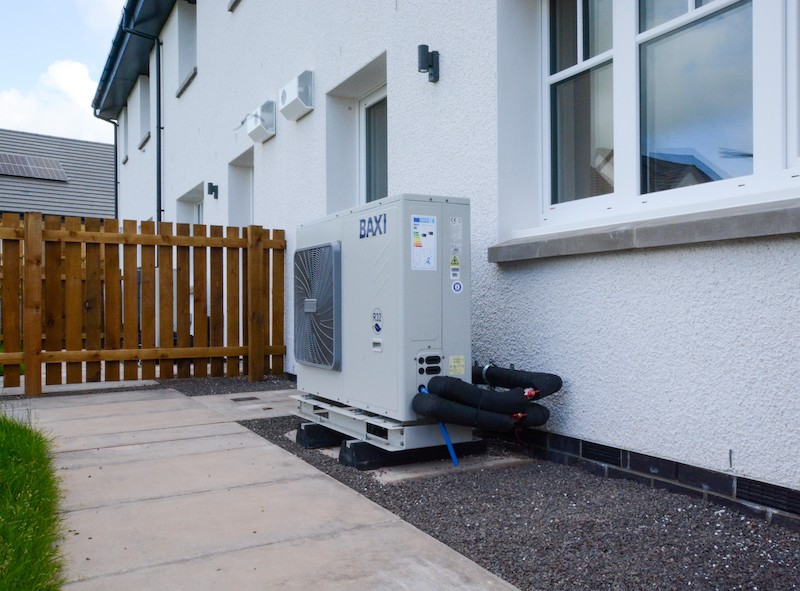
The UK’s commitment to reducing carbon emissions from heating and producing hot water in homes means there will be opportunities for installers to get ahead. Here, Jeff House, director of external affairs & policy at Baxi, looks at the possibilities presented by hybrid heating solutions.
Air source heat pumps (ASHPs) are a key technology for domestic heat decarbonisation, and their wide-ranging benefits make them a suitable mass-market heating solution. What’s clear is that the UK government sees them as a key tool in meeting net zero targets, even if the previous administration’s goal to install 600,000 heat pumps per year by 2028 looks like an overly ambitious growth target.
One reason for this ambition is that heat pumps provide low-carbon heating and hot water powered by increasingly renewable-generated electricity, not only improving energy efficiency but also reducing our national reliance upon fossil fuels. As highly efficient alternatives to traditional heating methods, heat pumps extract heat from the external environment and boost the temperature for use in heating and hot water production indoors.
However, in some circumstances, such as moving from a combination boiler to a standalone heat pump, installation can pose challenges in existing homes. For instance, the space needed for a hot water store can be a barrier and so can the likely need to increase pipework and radiator sizes to support low temperature operation. This, together with other factors such as upfront capital cost and a degree of consumer uncertainty, goes some way to explaining the slower rate of take up.
Tried and tested
In other European markets, the concept of a heat pump deployed alongside a boiler in a ‘hybrid’ configuration is widely accepted as a solution and is helping to accelerate decarbonisation.
A hybrid heating system consists of an ASHP functioning alongside a boiler with a shared control system to optimise performance. There are many different configurations of hybrid systems, making them suitable for a large variety of homes:
• Hybrid combination system – either an ASHP is added to an existing gas combination boiler or an ASHP and a new gas boiler are installed
• Hybrid with stored hot water – an ASHP is added to an existing or new heat only or system boiler with a hot water store
• Compact hybrid – an all-in-one unit containing a combi boiler and a small heat pump
The configurations of hybrid heating systems mean they can offer a solution for almost any residential building regardless of the amount of heat and hot water required. There are also upstream benefits to consider if hybrid systems were to be installed in numbers, such as energy system resilience and flexibility owing to the ability to switch between fuel vectors.
Clear benefits
At building level, the versatility of hybrid heating systems makes it easier for both installers and consumers to find the right solution for their needs.
For the consumer, hybrids are all about flexibility of choice given the various configurations on offer and the relatively low disruption installation.
One of the requirements many homeowners have for their new heating system is that it will help lower their bills. According to new research conducted by Gemserv and commissioned by Baxi, new and add-on hybrid systems can offer a lower upfront cost in harder to decarbonise properties. Running costs are not necessarily advantageous owing to the current spark gap but will benefit from potential government intervention on that issue.
Not only do hybrids offer a robust and flexible solution but also substantial carbon savings. For example, they can reduce emissions by 52% when compared with a standalone gas boiler and by 72% with an oil boiler when installed in an average mid-terraced house. Of course, the boiler element of the system could take advantage of lower carbon fuel in the future such as biomethane and other alternatives and the electricity grid will continue to decarbonise in coming years therefore giving greater savings.
Positive response
As well as homeowner benefits, hybrid heating systems offer plenty of rewards for installers because of the positive response they’re likely to receive from potential customers. Gemserv and Baxi’s research shows that many consumers are already aware of the reliability and carbon benefits of hybrid systems. Of the 764 responses used in the report, 50% stated they knew hybrids reduced carbon footprints and 50% said they understood them to be a “reliable home heating system”.
The research also shows that being able to place a boiler alongside a heat pump increases a homeowner’s potential to switch owing to perceived resilience. More than two-fifths (41%) of respondents said the option of keeping a gas boiler would increase their likelihood of switching to a hybrid system.
These results show there is certainly a viable market for hybrids as a transitional technology that installers can tap into through consulting homeowners on their heating and hot water needs.
Recent changes to the Microgeneration Certification Scheme (MCS) heat pump design standard, MIS 3005-D, recognise and give guidance with regard to hybrid system application.
Overcoming obstacles
However, barriers to mainstream adoption of hybrid heat pumps remain in the UK. At present, government subsidy and incentive schemes have a narrow technology focus and do not recognise or promote hybrid systems.
If the overarching aim of public spend in this area is to reduce carbon emissions, we would suggest that all viable technologies are considered and hybrids certainly offer a means to increase heat pump deployment.
As the UK moves away from more traditional heating and hot water systems, installers who are well versed in heat pumps and hybrid systems will be in good standing to capitalise on what is set to be a growing corner of the market.
Download the ‘Unlocking the Power of Heat Pumps with Hybrid Installations’ report.