The recently published Warm Homes Plan represents a major investment in heating upgrades, creating opportunities that plumbers and heating engineers can’t afford to miss. Harry Budd from Logic4training explores the technical skills and training that will enable modern multi-skilled installers to secure the best work.
Earlier this year, the government published the Warm Homes Plan, a £15 billion roadmap for cutting energy bills that will see five million UK homes upgraded by 2030. The plan sets out support, including grants and low-cost finance, to help households install low-carbon technologies, improve energy efficiency and save money on bills.
Much of the UK’s housing stock is old, poorly insulated and not designed for low temperature, low-carbon systems, so simply swapping one piece of kit is rarely enough to deliver real comfort and savings. The Warm Homes Plan aims to deliver whole home systems where possible, for example, a heat pump with upgraded emitters, controlled by smart thermostats and supported by solar PV and battery storage.
For installers, Warm Homes is about delivering integrated, well designed systems that genuinely improve comfort, cut bills and reduce emissions. It creates real opportunity for multi-skilled installers who can demonstrate competency, follow recognised standards and provide valuable advice to customers.
More heat pumps
The Warm Homes Plan sets a new target of 450,000 heat pump installations per year by 2030. With the timeline for the Future Homes Standard (FHS) now set, almost all new homes built from 2028 will have a heat pump. Meanwhile, the Boiler Upgrade Scheme (BUS) will fund retrofits until at least 2028, with an additional £1,500 available for those replacing oil or LPG heating, taking the total grant available to £9,000. Tens of thousands of new heat pump installers are needed to deliver installations at this level.
Heat pumps are sensitive to flow temperatures, emitter sizing, system cleanliness, controls and hydraulic layout, so there is much less tolerance for ‘fit and forget’ practices than with many legacy boilers. Installers need the ability to size systems correctly, design for low temperatures, understand manufacturers’ requirements and evidence commissioning.
Practical courses
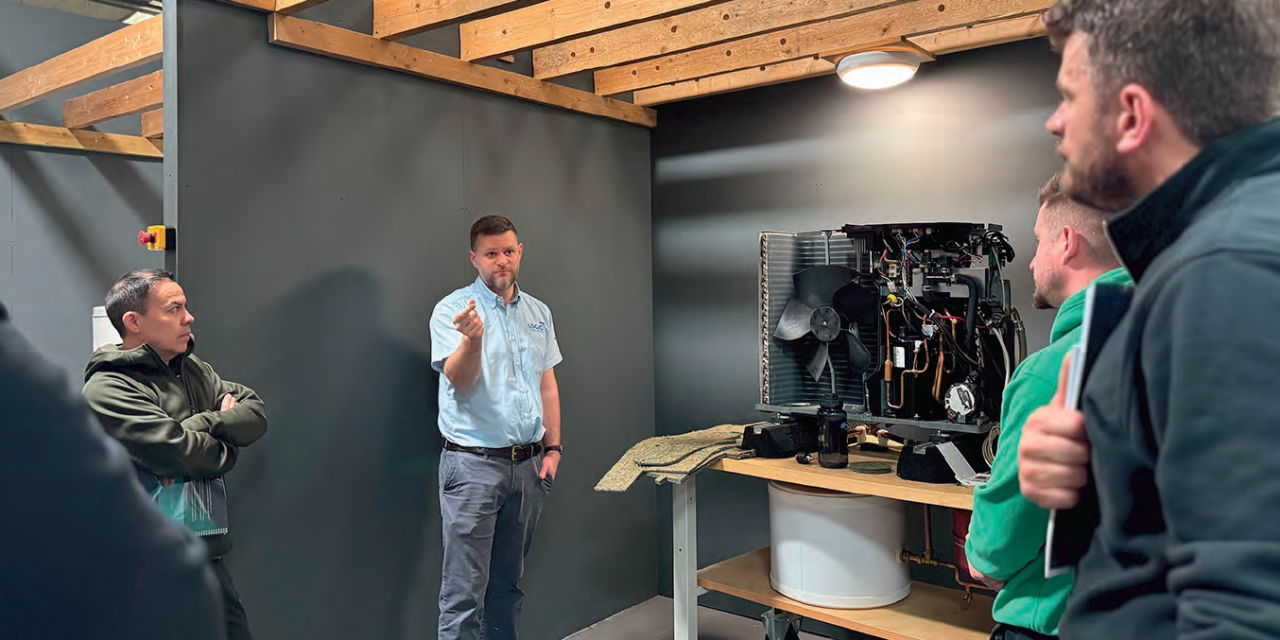
Level 3 heat pump training courses are aimed at existing plumbing and heating installers who want to top up skills for the heat pump market. The best training is largely practical and built around core learning outcomes that include planning, preparing, installing, and testing/commissioning non refrigerant circuit heat pump systems, plus the underlying principles of heat pump efficiency, hydraulic design and controls.
Manufacturer training is also essential. Heat pump manufacturers have their own designs, controls, refrigerant layouts and commissioning procedures, so installers need to learn how to install, configure and optimise specific heat pump systems, bridging the gap between qualification and confidence in the real-world.
Low temperature systems All heating systems are increasingly expected to be designed for low-temperature operation under Part L of the Building Regulations and the FHS. The LCL Awards Level 3 Low Temperature Heating and Hot Water Systems in Dwellings qualification, developed by CIPHE and the Heat Pump Association, is particularly relevant to heat pump installers. It covers room-by-room heat loss assessment and correct sizing for heat emitters, pipework, pumps and domestic hot water systems, ensuring installers understand evolving industry standards and deliver energy efficient heating systems.
Proving competence
To take advantage of new business under the Warm Homes Plan, installers will need to be MCS accredited. MCS sets the technical standards for the design, installation and commissioning of renewable energy systems, and without it, customers cannot claim government grants such as the BUS.
For smaller businesses that do not have the resources for full MCS certification, umbrella schemes offer a practical stepping stone to the renewables market. Delivered by most big heat pump manufacturers, umbrella schemes allow sole traders and small companies to operate under an existing MCS certified business, accessing the accreditation and its commercial benefits without carrying the full administrative burden.
The Warm Homes Plan offers a variety of national and local schemes, including the BUS and the Great British Insulation Scheme, together with local grants and social housing funds. It is expected that low-interest and interest-free loans will be launched next year.
While some funding is only for households on a low income, receiving certain benefits or living in a certain postcode area, other schemes, like the BUS, are available to everyone. It is worth checking both national eligibility and what your local council is offering, as many areas have additional funding pots that are not widely advertised.
The best advice for customers is to visit the government’s Help for Households pages, where they can find up-to-date information on all available schemes, eligibility criteria and application routes.
Planning ahead
The Warm Homes Plan is the biggest investment in retrofit in a generation, cementing low-carbon technologies in long-term policy and creating business opportunities for those with the right skills under their belt.
Existing plumbers and heating engineers are perfectly placed to capitalise on this increased demand. It’s time to get ahead of the curve by building expertise in heat pumps, low temperature systems and renewables, and positioning yourself at the front of the queue when the work arrives.