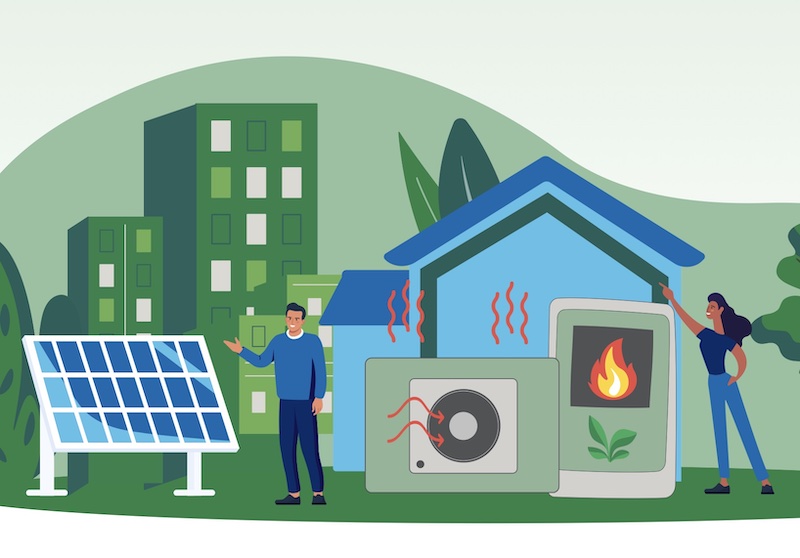
The Competition and Markets Authority (CMA) has released a comprehensive report highlighting the challenges consumers encounter when buying low-carbon and renewable home heating technologies, such as heat pumps, solar panels, and biomass boilers.
While the evidence highlighted that people could have a positive experience buying green heating and insulation products, it also raised concerns about its complexity and a lack of information.
The report reveals that consumers are facing obstacles and unfair treatment, with concerns about complexity, lack of information, misleading claims, and inadequate consumer protection. Without consumer confidence in this developing sector, the report notes, there is a risk that people will be put off from buying green heating and insulation products, and this will ultimately affect the UK’s drive towards net zero.
The CMA also found that quality assurance schemes – which play an important role in the sector – could do more in some areas to protect consumers better.
Three areas of concern were identified in the report:
Information about products is difficult to find and to understand
- People often don’t know where to start to get the information they need.
- Unnecessarily complicated information risks putting consumers off from buying green heating products or leading them to install the wrong systems for their homes.
Not all businesses are acting fairly
- Some businesses may be making misleading claims about the cost saving or environmental benefits of their products.
- Businesses marketing boilers as ‘Hydrogen-blend’ or ‘Hydrogen-ready’ risk greenwashing people into thinking these products are more environmentally friendly than they really are. This is despite these boilers being technically the same and emitting the same carbon emissions as standard gas boilers, because hydrogen fuel is not currently available for home heating.
Quality assurance schemes are not as effective as they can be
- There are several different quality assurance schemes, which can be confusing for people to understand. The level and robustness of protections these schemes give to consumers also varies. Some people might miss out or have less protection than others especially if something goes wrong.
To help people looking to buy green heating and insulation products, the CMA has published a new consumer guide. It sets out key considerations for people at each stage of the buying process and summarises their rights under consumer protection law.
Alongside the consumer guide, the CMA has published a set of good practice principles for quality assurance schemes and will work with scheme providers to implement these principles, as well as with the UK governments to help better support and protect consumers in this sector.
Ian Rippin, CEO of MCS, comments: “We recognise many of the issues that the CMA highlight. In particular the conclusion that ‘without consumer confidence in this developing sector, there is a risk that people are put off from buying green heating’. This was a feature of our own report, published in 2022, on consumer protection in small-scale renewables.
“Our upcoming consultation, which we will publish next week, outlines proposed changes to MCS which not only improve the robustness of our scheme as a recognised quality mark, but bolster safeguards for consumers. Our proposals address many of the challenges described in the CMA report in relation to small-scale renewables, including what the CMA refer to as ‘green heating’.
“MCS will have a central role in giving consumers confidence as they embrace the benefits of decarbonising their home heating and generating their own electricity. That’s why we strive to deliver our mission ‘to give people confidence in low-carbon energy technology by defining, maintaining and improving quality’.”