
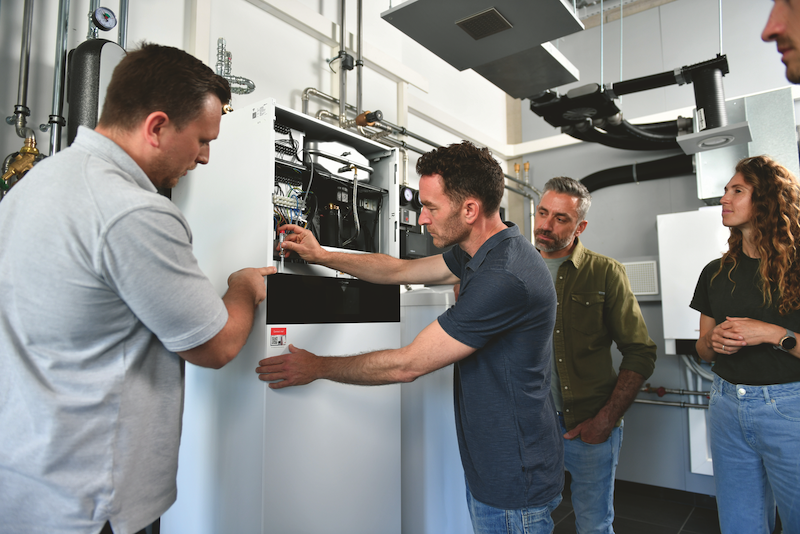
As many manufacturers now make their product education optional, Viessmann Academy’s technical trainer Toni Oakley-Tulk explains why in-depth technical workshops remain crucial for installers seeking to stay ahead in a fast-changing market.
In recent years, a number of manufacturers have eased requirements for installers to complete product-specific training courses before achieving accredited status or qualifying for certain benefits. The goal has been to remove barriers and encourage uptake, particularly as the industry transitions to low-carbon technologies.
However, while participation may no longer be mandatory, hands-on short courses still offer installers significant professional advantages, from technical competence to market knowledge. These in turn can help to build customer confidence and enhance business performance.
The value equation
For most heating engineers, time and money are the main obstacles to taking advantage of learning opportunities, however valuable they may be. This is true even if there’s no fee to attend. As well as the difficulty of finding space in the diary, a day spent in a classroom or training centre usually means lost earnings. Travel and accommodation costs can also add to the financial burden.
As a result, many installers are compelled to weigh up whether attending a course is worth the investment if it’s not tied directly to certification or legal compliance. And the temptation to focus on day-to-day projects at the expense of future security can be overwhelming.
But product workshops should not be viewed as optional extras. Not only do they contribute towards continuing professional development, but they can deliver immediate, practical benefits too.
Deep-dive product training is essential for learning how systems differ in design, performance and operation. Each manufacturer uses slightly different components and methodologies to build their appliances, while approaches to aspects such as control mechanisms, weather compensation and refrigerant choice (in the case of heat pumps) can vary considerably. All of this can affect efficiency, maintenance and environmental impact. For example, the Global Warming Potential (GWP) of some refrigerants is several hundred times higher than that of others.
Technology differences can also have a significant effect on cost – not just of the purchase price of the unit itself but also on running costs and any building upgrades needed to optimise the installation. For instance, certain heat pump models may require larger radiators or pipework to operate effectively. Being able to understand and communicate these distinctions helps installers guide customers to the best solution for their needs and budget.
Beyond the manual
Another major advantage of in-person product training is the opportunity to go beyond what’s written in the manual. Workshops allow engineers to see how products are built, ask questions about real-world installation challenges, and hear practical tips directly from experienced trainers.
These insights, drawn from years of field experience, can prevent costly mistakes and reduce the time spent troubleshooting on site. Participants can also examine marketing claims more closely, ensuring that their advice to customers is grounded in first-hand understanding rather than sales material.
That kind of depth simply isn’t achievable through self-study or online resources alone.
Confidence in knowledge
It’s not just installers who are genning up on heating products, however. As government policy continues to encourage households to switch from gas boilers to bigger-ticket low-carbon heating systems, homeowners are increasingly doing their own research and becoming more informed about the options available to them. Many heat pump customers, in particular, now research brands and systems extensively before contacting an installer.
This can lead to detailed and sometimes challenging conversations. Customers may arrive with specific ideas about the products they want, but not always a clear understanding of what’s suitable for their property. In these situations, an installer’s ability to explain the technical reasoning behind a recommendation is invaluable.
Comprehensive product knowledge builds confidence, helps establish trust and, ultimately, increases the likelihood of winning and retaining business.
Avoid the costly pitfalls
The rapid rise in heat pump installations has highlighted how crucial proper product understanding is. The hands-on product experience gained during a manufacturer’s technical workshop can often make the difference between a high-performing system and a failed installation.
Too often, poorly designed or incorrectly commissioned systems undermine customer confidence and damage the reputation of low-carbon technologies. Many of our renewables-specialist installers tell us that they’re called in to completely reconfigure failing heat pump set-ups several times a month. Occasionally, they encounter an installation so poor that the appliance itself has been damaged beyond repair and requires replacing, causing huge expense and stress for the client.
Such issues are rarely the fault of the technology itself but rather a lack of detailed installer knowledge. Comprehensive training helps prevent these outcomes, ensuring systems are installed and commissioned to perform efficiently and reliably from day one.
Why training still counts
Even as the industry shifts towards more flexible accreditation models, the benefits of hands-on manufacturer training remain undiminished. For heating engineers, it’s an investment in skill, confidence, and customer satisfaction.
The immediate cost of taking time away from client work is outweighed by the long-term advantages: fewer call-backs, smoother installations and greater trust from customers. In a market where homeowners are better informed than ever before and technology is evolving rapidly, keeping product knowledge up to date isn’t just an option – it’s a professional necessity. Manufacturer training remains one of the most effective ways to maintain that edge.
