
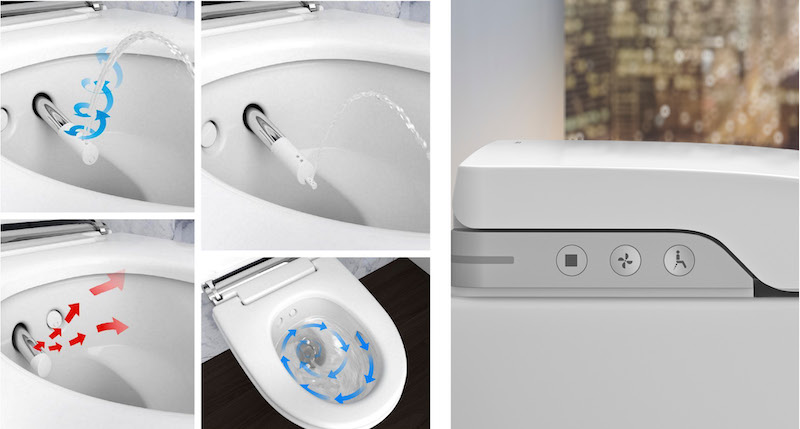
Fitting a bidet in Britain’s typically tiny bathrooms can be a challenge, but what if your customer could have a WC with the bidet built in, along with a host of other features that turn the humble toilet into a high-tech throne? Carol Hitchcock, assistant editor at PHAM News, reports on the latest in shower toilets.
When you are designing a bathroom for a customer looking for the ultimate in luxury, there are endless choices to help you exceed their expectations and create the bathroom of their dreams. Whether it’s a digital shower or a bathtub fitted with lights and sound, or an LED Bluetooth mirror that doesn’t fog up, there seems to be a clever product for every conceivable demand. But how can you improve upon the humble toilet?
Thanks to the efforts of manufacturers over the years, the toilet has been treated to a variety of design enhancements that has given us things like soft close seats, concealed cisterns, dual flush plates, rimless bowls and wall-hung WCs to name just a few. For many in the UK, this might represent the zenith of toilet design, but they’ve probably never experienced the joys of the shower toilet, arguably the most sophisticated version of the porcelain throne you can buy.
Unseen benefits
Sometimes called ‘smart’ toilets or bidet toilets, the shower toilet at its most basic is a WC with built-in bidet functions to offer outstanding standards of hygiene. The bidet is discreetly built into the bowl and emerges at the touch of a button to shoot a jet of water right where you need it. It’s essentially a hands-free process, and who wouldn’t want that? Top-of-the-range versions offer so much more, like heated seat, drying function, deodorizers and night lights. Either way, shower toilets of any specification can give your customer the ultimate in cleanliness, hygiene and comfort. The only problem is, most customers have no idea that they are an option for their own bathroom.
The shower toilet is not a new concept. About 100 years ago an American patented a device that incorporated bidet functions into the standard toilet, but it would be decades before the idea was commercially viable. In the 1950s, Swiss company Closomat sold its first ‘wash and dry’ toilet to the disabled market to provide independence and dignity in toileting, with added benefits of improved personal hygiene. However, the Japanese are credited with perfecting the shower toilet – global toilet brand Toto mass produced the first ‘Washlet’ bidet toilet seat in the early 1980s and since then has sold more than 40million units worldwide.
Today, over 80% of Japanese households have shower toilet facilities. The same cannot be said in the UK, where WCs are a bit more ‘bog standard’ and usually adorned with a packet of wet wipes on the back of the cistern. European manufacturers, however, are making strides in bringing shower toilets to the UK with the aim of making them a bit more common, if not mainstream.
Market trends
Shower toilets in the UK are largely pitched at the high-end of the market. Some brands will cost in the thousands of pounds, but considering the country’s significant population of aging people with disposable income, and a desire to stay in their own homes as they become less independent, shower toilets are an attractive investment for them.
Manufacturers have incorporated plenty of high-tech gadgetry into their shower toilets that go some way in justifying the hefty price tag. Claire Gay, Marketing Manager at Roca, says their many benefits suit them to a wide variety of users. “In homes they are perfect for multi-generational living where all ages can benefit from their functionality,” she says. “Alternatively, in a hotel shower toilets can meet the cultural needs of guests whilst not requiring extra space for a bidet. The applications are broad.”
For some disabled people, the shower toilet may be the only way they can maintain independence and privacy in this area of life, and manufacturers have specifically developed models that answer this need. Holly Aspinall, Marketing Manager at Geberit, says: “Most units are specified by occupational therapists through DFG (disabled facilities grant) funding and they give users a better quality of life. A shower toilet allows you to clean the most sensitive part of your body gently and thoroughly and leaves you feeling exceptionally clean.”
With so much going for them, shower toilets have the potential to make a big impact in the UK. Margaret Talbot, Marketing Manager for VitrA, says: “Rarely do we see a product with so much potential to deliver so many genuine lifestyle benefits. The showering WC is pivotal, along with products like level-access showering facilities. Toileting and bathing are critical to allow older consumers to maintain their independence, so products that allow them to stay at home will be in high demand.”
High-tech toilets
Technology plays a key role in product development. Claire Gay says that the growth of technology within the home in general is helping to normalise using technology in the bathroom. “In the past people may have been unsure about the functions of a shower toilet,” she says, “but that is changing. We created our In-Wash Inspira range knowing that consumers are becoming more accustomed to using technology, so they are interested in having extra functions such as a dryer, deodorizer or a self-opening heated seat.
“We have been working to incorporate more functionalities into our In-Wash Smart Toilets. For example, there is a new ground-breaking dryer that has been designed based on modern aerodynamics. This technological innovation projects air in one single direction and, together with its turbo option, provides an enhanced level of drying.”
Tailored experience
Geberit is also emphasising its technology advances. For example, it has recently expanded its AquaClean shower toilet range with the launch of the Sela, which features an oscillating spray of warm water. Holly Aspinall explains:
“The Sela introduces innovative technology. It has four programmable buttons so an individual can tailor their experience by customising everything from the temperature of the water to the water pressure itself via the remote control, a wall-mounted control panel or an app. It even has a lighting feature that activates when a user approaches in the middle of the night. Plus, the Geberit AquaClean range can also be controlled by voice recognition with the app,”
The V-Care Comfort is VitrA’s best selling shower toilet. It is a wall-hung WC that features a sensor that opens the lid as the user approaches, adjustable washing and drying, and a heated seat. The integrated shower functions are activated with the remote control. The remote can also be used to control the temperature of the heated seat, while primary functions of the WC can be controlled via touch buttons on the right and left sides of the pan.
Installation ease
When it comes to installing shower toilets, the main consideration will be access to power connections. Shower toilets require an electrical supply with a fuse switch (usually located outside the bathroom – like the extractor fan) and a separate water feed. Good plumbers will find them straightforward to install, and manufacturers are at the ready with technical support should you need it.
The UK may not be at risk of shower toilets flooding the market any time soon, but there is plenty of room for growth. People are coming to expect more from their bathrooms as they look to create the perfect retreat, and a WC offering superior hygiene, comfort and convenience can go a long way in achieving that aspiration.
Find out more
For more details on the products referenced in this article, please visit the following websites:
geberit-aquaclean.co.uk
www.uk.roca.com/smart-toilets/in-wash/
www.vitra.co.uk
