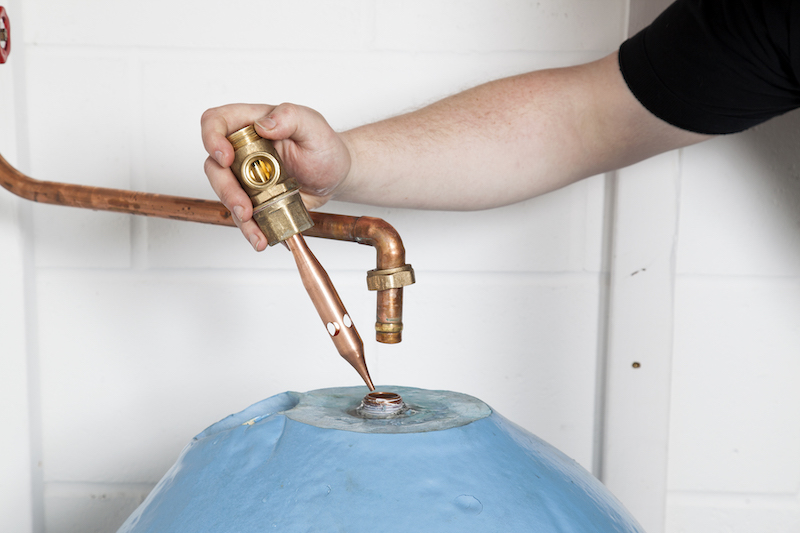
If the water flow from a shower is little more than a trickle, installing a shower or whole house pump to boost this flow is a clear solution. However, when installing a shower pump it’s crucial to make sure that any air from the system is not drawn into the pump (systems will always have some air) as this can cause damage to the pump. To help overcome this, it’s important to fit a flange during installation. Here, Ken Vance, training manager at Salamander Pumps, explains all you need to know about installing a flange.
What is a flange?
A flange is a device that limits the amount of air entering a pump from the hot water cylinder. When water is heated, or replaced within the hot water cylinder, air bubbles are formed and collect around the side or the top of the cylinder. The bubbles then rise up to the top of the vent and expansion pipe. By installing a flange, these air bubbles are prevented from entering the pump, as the flange is able to draw water from deeper within the hot water cylinder.
Why is a flange so important?
Flanges are crucial in ensuring longevity of life and quiet running for the pump. In fact, some Salamander pumps require a flange to ensure a valid warranty.
Having an aerated supply of water to a pump, showers and other outlets can cause a whole host of problems, including unnecessary, and perhaps sudden, fluctuations in temperature, increased noise levels, accelerated degrading of the pump’s internal workings and cavitation, which can lead to an eventual leak, and a premature breakdown of the pump.
Whilst some warranties require a flange to be fitted, in some installations, regenerative pumps (for example, the Salamander CT range) do not necessarily need a flange, provided that the pump is installed at the base of the hot water cylinder, the cold-water tank is higher than 1.2m above the hot water cylinder, and the pump is ‘teed’ off the first downward leg from the cylinder. This is because the robust nature of a regenerative pump can cope better with some minor, temporary aeration avoiding the need for a flange.
However, in general, the best option for all pumps is to fit an anti-aeration flange to the hot water cylinder, so that a dedicated supply feed can connect the flange directly to the hot inlet on the pump.
Choosing the right flange
There are various flanges available for a shower pump installation, including a Surrey Flange (such as Salamander ‘S’ Flange), a Warix Flange, and a Non-Stop Essex Flange. Therefore, it’s important to check the fitting guide ahead of installation to ensure an appropriate flange is installed.
The Surrey and Warix flanges are both top entry flanges, meaning that they screw onto the hot draw off connection on the dome of standard type hot water cylinder.
In comparison, the Non-Stop Essex flange is a side entry flange, which requires drilling into the side of the cylinder. This flange is best for when a pump needs to be situated above the hot water cylinder.
For more information, visit www.salamanderpumps.co.uk