Unico’s small duct high velocity (SDHV) technology represents an all-in-one heating, ventilation and air conditioning system, promising to deliver reduced humidity, improved air quality and a space-saving heating solution. MD Richard Soper explains how the system works and the opportunity for installers to get up to speed.
As the UK construction sector accelerates towards low-carbon buildings, the role of the installer/HVAC engineer is changing rapidly. Delivering modern homes is no longer just about installing a heat source – today’s buildings require controlled airflow, effective ventilation, good indoor air quality (IAQ), and reliable heat pump integration that work together as one system.
Tighter building envelopes, higher insulation levels and stricter regulations mean there is far less margin for error. Poor airflow design, incorrect commissioning or a misunderstanding of how systems interact can quickly lead to complaints, efficiency losses and callbacks, so the need for high-quality, practical training is more important than ever.
For many installers, skills have traditionally been developed over time by learning from repeat installations and solving problems as they arise on site. Although this approach worked with legacy heating systems, it is far less effective in today’s low-temperature, low-carbon environment.
Heat pumps, mechanical ventilation and modern distribution systems behave very differently from traditional boilers and radiators. Issues such as noise, uneven temperatures or poor IAQ are often not visible at first fix, only appearing once a building is occupied, which is why understanding airflow, pressure and system balance is becoming just as important as pipework or electrical connections.
Practical learning
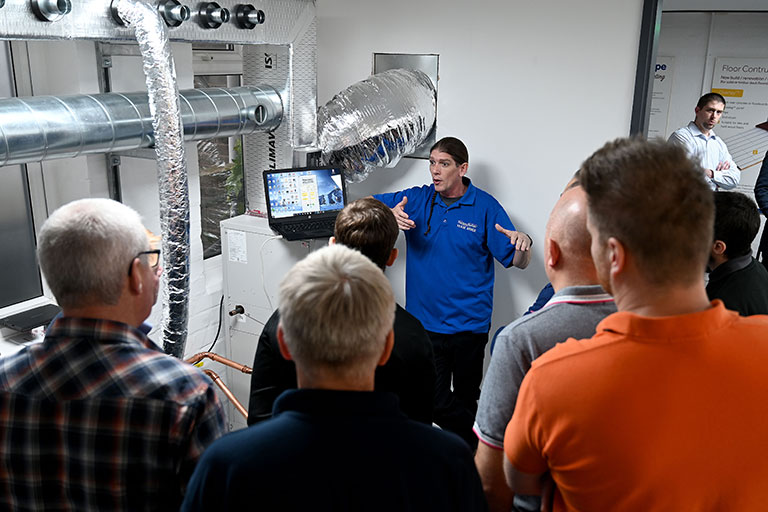
One of the most effective ways to close this knowledge gap is hands-on training using live, working HVAC systems, such as our Unico specialist training centre based in Birmingham. Being able to see and interact with an operating installation gives a far better understanding than classroom theory alone.
Live systems allow trainees to:
• Observe airflow and pressure distribution in real time
• See the effect of poor detailing or incorrect duct sizing
• Understand commissioning, balancing and optimisation in practice
This approach is especially valuable for anyone working on apartments, retrofit projects or homes where space constraints demand more careful planning. Rather than learning through trial and error on-site, professionals can build confidence in a controlled training environment.
Airflow and IAQ
With increasing attention on occupant health and wellbeing, as well as the health of the building, ventilation and IAQ are now core parts of system design. Regulations such as Building Regulations Part O and Awaab’s Law highlight the risks of poor ventilation, particularly in airtight dwellings. This means ventilation can no longer be treated as an afterthought. The training therefore needs to cover:
• Correct airflow rates and distribution
• Balancing supply and extract
• Managing moisture, pollutants and temperature
Systems that combine heating, cooling and ventilation require the installer to take a whole-building approach, considering how each element affects comfort and performance throughout the property.
Heat pump integration
Heat pumps continue to be widely specified, but system performance depends heavily on how effectively heat is distributed. Poor compatibility between the heat source and the distribution system can lead to inefficiency, noise issues and dissatisfied clients.
A training environment that includes multiple heat pump brands working alongside ventilation systems allows trainees to understand these integration challenges before encountering them on site and provides exposure to different configurations. Rather than promoting a single solution, this multi-brand approach also helps to develop transferable knowledge across different projects.
Training programme
As systems become more technical, informal learning is increasingly being replaced by structured training programmes. Modular training covering system design, installation, commissioning, servicing and optimisation provides a clearer progression route.
Blended learning models that combine practical sessions with online modules provide an opportunity to develop new skills without extended time away from the site. Importantly, CIPHE-accredited training pathways also provide formal recognition of competence, offering reassurance to employers, housing providers and specifiers.
Effective programmes address real-world compliance by referencing the regulations that installers encounter every day, such as Building Regulations Part L and Part O, the Future Homes Standard, as well as SAP and HEM methodologies.
Understanding how installation decisions affect energy performance calculations and regulatory sign-off also enables HVAC engineers to engage more confidently with designers, assessors and building control officers.
Unico training options
To support installers at all stages of their development, we offer a range of flexible training options:
• Online training through Unico University and a CPD module available on the website
• In-person training at our dedicated, state-of-the-art training centre
• On-site training support during a first Unico installation, providing practical guidance and confidence in real project conditions
This blended approach ensures learning is accessible, practical and directly relevant to real installations. The modern installer is expected to understand more than individual components – success now depends on knowledge of airflow, comfort dynamics, low-carbon integration and regulatory compliance.
Hands-on, system-based training that mirrors real installation challenges, is playing an increasingly important role in preparing installers/HVAC engineers for the future, not just to meet standards, but to deliver buildings and homes that perform as intended.
Join the network
We are actively looking for skilled and motivated HVAC engineers to become Unico System Partners (USPs). If you are interested in expanding your expertise and working with innovative HVAC solutions, we would welcome the opportunity to support your journey. For more details, please use the online link below