The Future Homes Standard will be adopted fully in less than 12 months, changing the way homes are heated in the UK. Here, BEAMA’s Chris Stammers explains about the changes already in place, what’s to come, and why radiant heating ticks every box.
The UK government’s Future Homes Standard (FHS) is part of its strategy to achieve net zero carbon emissions by 2050, which is a legally binding target. The standard is also intended to reduce energy bills for while providing warm and comfortable homes.
As the first stage of meeting the FHS, some amendments have already been made to the Building Regulations. An uplift to Part L, which covers the conservation of fuel and power, came into force in June 2022 and introduced new standards for the performance of building fabric and building services. This included a new maximum flow temperature of 55°C for newly installed wet heating systems, affecting new homes and properties undergoing major renovations or extensions.
In this new era of home heating, heat pumps are fast becoming the go-to solution. When paired with a low-temperature emitter, the two solutions work seamlessly together to support a low carbon heating system. Standard radiators, such as those previously used with gas boilers, will no longer be suitable for low-temperature heat sources, and larger, more costly units would be the only option – taking up even more valuable wall space in properties and causing interior layout issues for new builds or extensions/renovations.
However, as heat pumps have far fewer tolerances than the industry is used to, especially when compared to traditional heating systems, precision design and installation are critical to ensure the finished system delivers exactly what was planned.
Underfloor takes the lead
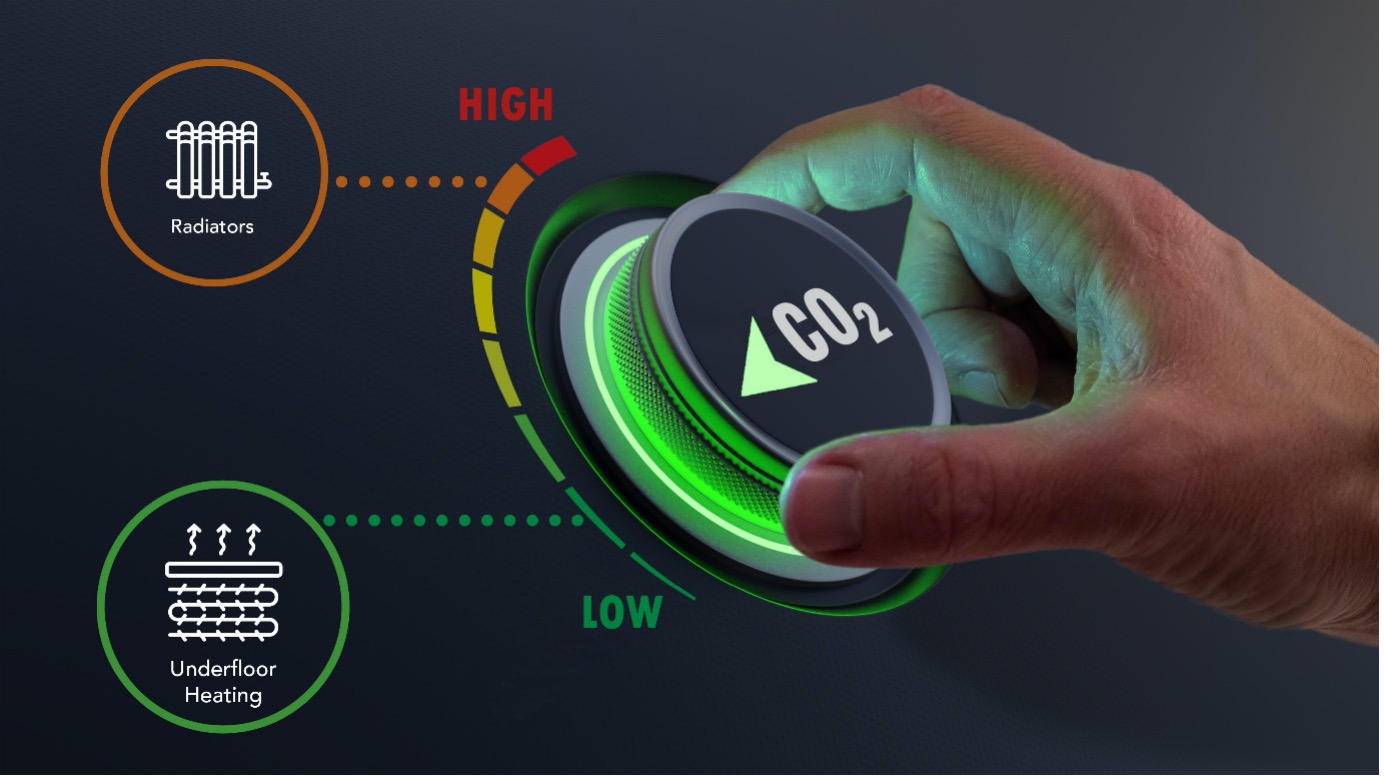
Hydronic (water-based) underfloor heating has always been, by its very nature, a low-temperature system dating back to Roman times. It is the ideal solution to meet the revised regulations. It covers a much greater surface area than radiators and is designed to run at low temperatures, 35°C rather than the 70°C of a typical radiator system. This key benefit also makes integrating underfloor heating with renewable energy sources ideal and more efficient as the system doesn’t have to work as hard – therefore using less energy, making it more efficient than an equivalent radiator system.
Working at these much lower temperatures allows for efficient heat transfer evenly across the entire floor surface, reducing heat loss during distribution through the floor and minimising energy consumption. In addition, the insulation layer incorporated in some underfloor heating systems also helps to minimise downward heat loss by directing heat upwards into the property, improving comfort levels and overall efficiency.
Underfloor heating systems can also be fully zoned, which ticks a crucial regulatory box and ensures no energy is wasted. Each zone can be controlled individually from a central thermostat or a smartphone app.
Longer view
Aside from specifying and installing high quality pipework and components which offer long term reliability, it’s also possible to futureproof an underfloor heating system design to accommodate heat source upgrades.
One way to ensure the system’s benefits can outlive the gas boiler currently in place is to position the pipe centres close enough to work with lower-temperature heat sources, for example. The system can be further enhanced by selecting a pipe size more suited to a higher flow volume, as smaller pipes simply can’t deliver the same flow that a larger pipe can accommodate.
Working with a supply partner who can provide system design expertise is beneficial when helping a customer plan ahead. An incorrect design can lead to an under-specified heating system, meaning the desired heat output in each area is not achieved, resulting in more service call backs and maintenance issues.
Service life
Further adding to the long-term benefits of underfloor heating, traditional radiators are only expected to last for around 25 years. They are also less efficient than underfloor heating when in situ—once decommissioned, they become a waste product in a relatively short space of time. Underfloor heating systems can last three times longer and offer extended guarantees, providing additional reassurance that they will likely outlive the lifetime of the building.
Consumer education
When it comes to retrofitting or renovation projects, installers play a crucial role in educating customers about the benefits of energy-efficient heating systems and helping them make informed decisions about efficient, future-proof options.
The transition away from traditional gas boiler/radiator systems to low-temperature solutions will be a significant change from what customers are used to. Homeowners will need to shift their mindset as they move from an ‘on/off’ approach when controlling radiators to a more efficient programme for their underfloor heating system.
Customers will notice the response time is very different from that of a standard radiator heating system, particularly for screeded systems. It’s important to feel informed and ready to help them understand the features and benefits of low carbon heating technologies and how the heating system works, including controlling it, ensuring they can reap the many rewards available – from lower energy bills to improved comfort and reliability.